 NexBrowser指纹浏览器-官方博客Blog
When you're weighing the cost of your multi-account matrix and considering switching to ultra-cheap IPv6 proxies, here's the conclusion: IPv6 proxies have limited feasibility in cross-border multi-account isolation. They're only suitable for short-term tasks like public data scraping; core accounts and high-value accounts should not be swapped directly. In 2026, pressure on proxy costs has boosted marketing for low-priced IPv6, but Common Crawl data from March of the same year (probing the top 100,000 sites globally) shows that only about 36.9% of sites fully support IPv6. This ecosystem gap means 'cheap' does not equal 'interchangeable'.
Why So Cheap: The Fundamental Difference Between IPv6 Address Supply and IPv4 Residential Resources
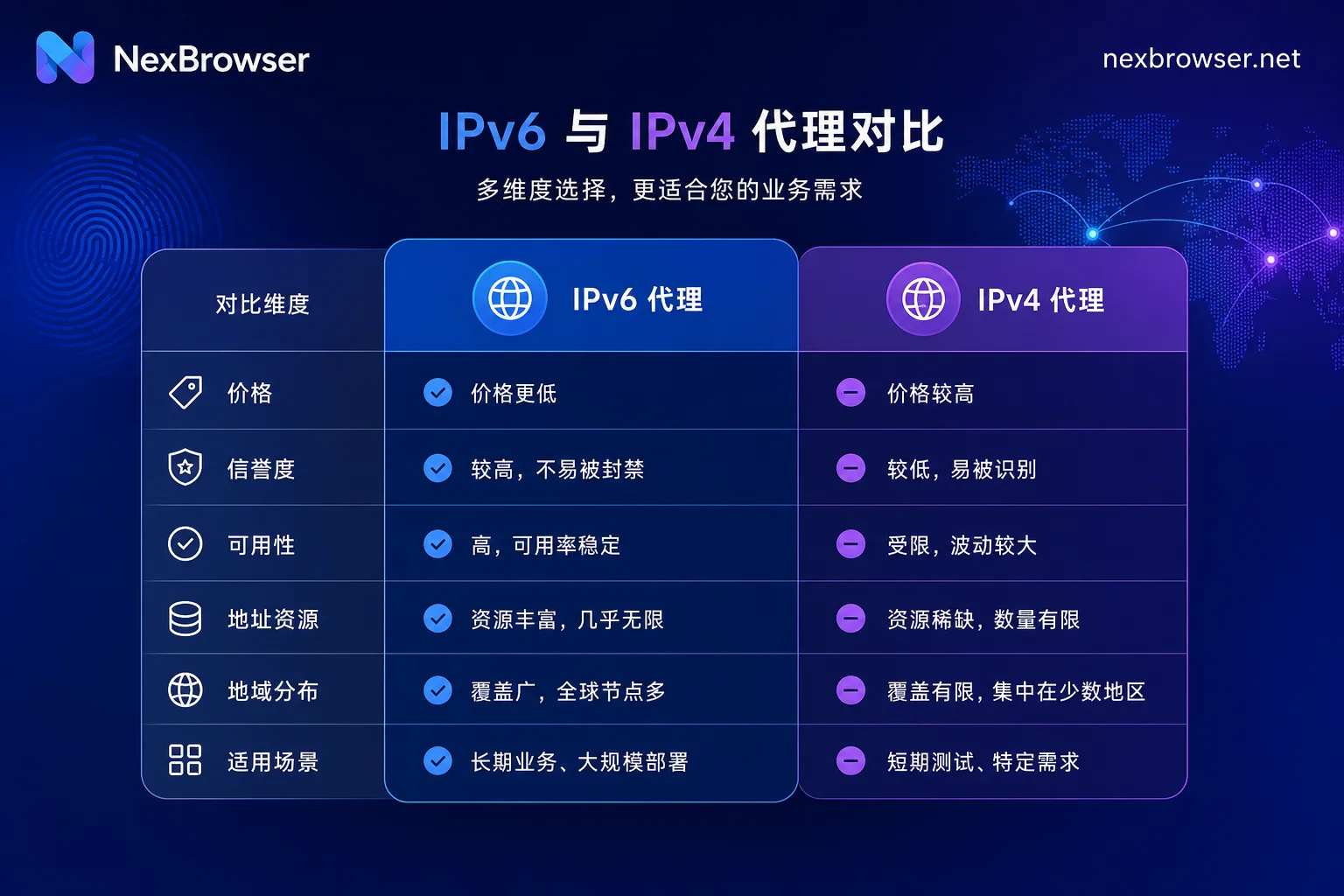
The low price of IPv6 proxies stems from the abundance of address space. With a vast number of IPv6 addresses, allocation costs are low, and a single IP often costs less than a tenth of an IPv4 residential address (based on proxy type comparisons by Multilogin and NodeMaven from August 2025 to February 2026). In contrast, residential IPv4's value comes from scarcity and the reputational history of real users—a reputation that the massive IPv6 address pool cannot replace. Understanding this difference clarifies that 'cheap' is determined by supply structure, not vendor generosity, and does not imply equivalent isolation. That's why low-cost IPv6 proxies haven't massively replaced residential IPv4 in multi-account isolation scenarios.
Failure Mode One: Why IPv6 Proxies Can't Connect to Some Websites
When using a pure IPv6 proxy to access a site that doesn't support IPv6, typical symptoms include page load failures, API timeouts, or silent connection hangs. Common Crawl's March 2026 data shows that 61.9% of top sites have no AAAA records at all (i.e., IPv4-only), and another 1.2% have configuration unreachable errors. Major e-commerce and social platforms (e.g., Amazon, LinkedIn) have limited support on core endpoints or still rely on IPv4 for some endpoints, so using IPv6 proxies to log into these platforms easily triggers anomalies. This explains 'why IPv6 proxies can't connect to websites'—likely the target endpoint simply doesn't support IPv6. When binding proxy IP to a browser, first verify the target endpoint's IPv6 reachability.
| Endpoint Type | Percentage | Impact on IPv6 Proxy |
|---|---|---|
| Full IPv6 support | 36.9% | Can access normally |
| No AAAA records | 61.9% | Connection failure or timeout |
| Configuration unreachable | 1.2% | Connection reset |
Failure Mode Two: Dual-Stack Fallback—Can IPv6 Proxies Expose Your Real IP?
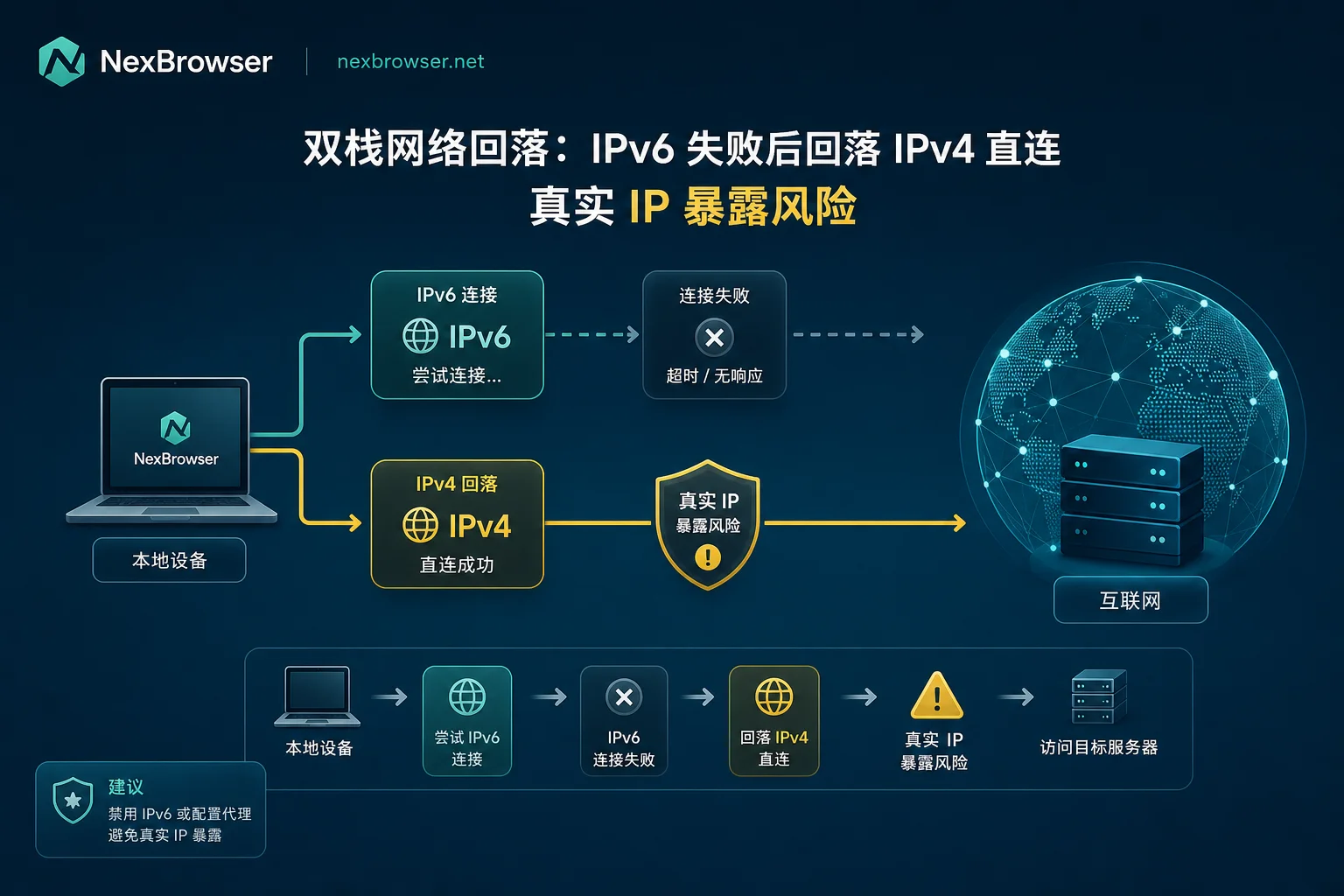
This is the technical detail to watch out for most. In dual-stack networks (supporting both IPv4 and IPv6), when the IPv6 path fails, the system may automatically fall back to IPv4, exposing your real exit. There are three specific leak paths to understand:
- Happy Eyeballs race: The client concurrently attempts IPv6 and IPv4 during connection, using whichever succeeds first. If IPv6 times out, the client seamlessly switches to IPv4 without any visible UI indication. The effect: software shows proxy connected, but actual traffic may have gone through the local IPv4 exit.
- Local DNS resolution split: If the proxy doesn't take over DNS, domain resolution happens locally, and the resolved IP and request exit may follow different network paths. The effect: pages load normally, but some sub-resource requests bypass the proxy and originate from the machine.
- WebRTC probe: WebRTC uses STUN to directly obtain local network interface addresses, bypassing the proxy channel. The effect: even with correct proxy config, some pages can still see your local IPv4 address, creating fingerprint linking.
These mechanisms form the core risk points behind 'can IPv6 proxies expose real IP'. The result: even if software shows a successful connection, actual traffic may not fully go through the proxy, and multiple environments share the same real IPv4 exit underneath, leading to batch associations.
Failure Mode Three: Concentrated Subnets—More Addresses Doesn't Equal More Independence
IPv6 proxies are often allocated as whole /64 machine room subnets. Risk control systems can easily determine multiple accounts as originating from the same /64 prefix, leading to same-source matrix detection. More addresses only mean more available IPs, but independence is weak. In contrast, static residential IPv4 addresses are more dispersed, each with its own reputation, offering better isolation. Therefore, you can't assume 'more addresses means harder to track'; subnet concentration actually increases clustering risk. Multiple environments under the same /64 prefix being identified as a same-source matrix is typical cross-border account risk control clustering logic, largely unrelated to whether a single IP is clean.
Scenario-Based Judgment: What You Can Try vs. What Accounts to Protect
Applying the three failure modes to specific use cases, we can break down IPv6 proxy feasibility in cross-border multi-account isolation into 'try' and 'not recommended' categories.
| Use Case | Recommendation | Rationale |
|---|---|---|
| Public data scraping | Can try | No login state, low failure cost |
| Reachability testing without login | Can try | Can first probe target endpoint's dual-stack support |
| Main store login | Not recommended | Reputation accumulation, high failure cost |
| Ad accounts | Not recommended | Sensitive operations, easy to trigger review |
| Social media main accounts | Not recommended | Reputation building important, high risk |
| Payment and settlement operations | Not recommended | High security requirements, need stable exit |
Three Checks Before Switching: Connectivity, Exit Address, and Protocol Family Consistency
- Verify proxy connectivity: Use online proxy detection tools to confirm the proxy can access target sites.
- Verify actual exit address: Visit IP detection sites to ensure the displayed IP is the proxy IP, not your local IP.
- Verify exit protocol family: Confirm whether the exit uses IPv6 or IPv4 to avoid falling back to IPv4 direct. Also ensure DNS resolution is remote and WebRTC is disabled or its IP replaced to prevent local resolution leaks.
How to Implement in NexBrowser: Per-Environment Binding and Post-Switch Exit Spot Checks
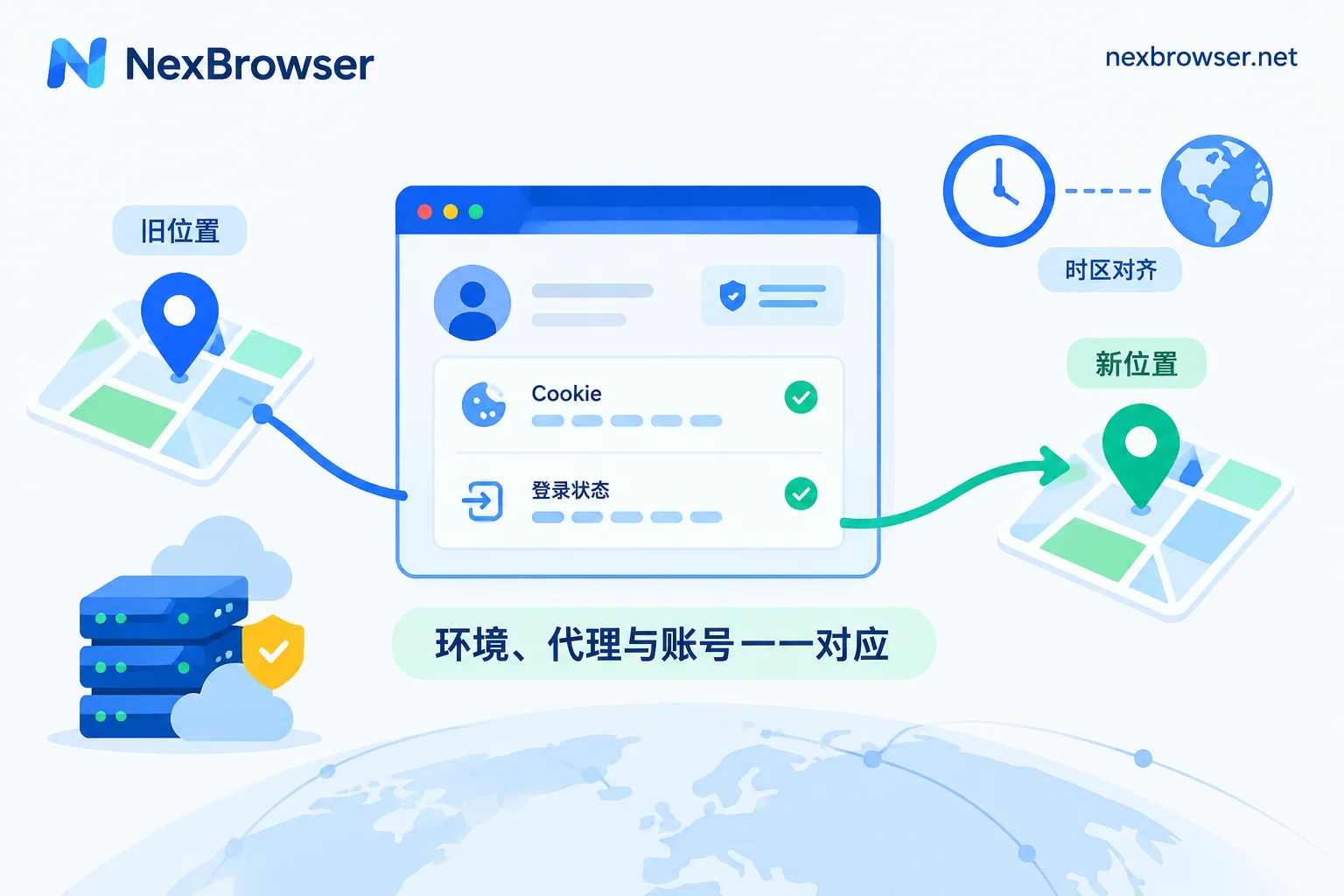
NexBrowser binds proxies at the individual browser environment level. After switching proxy protocols, you can check the actual exit address and protocol family per environment, rather than relying only on in-software connectivity tests. For existing historical environments, batch spot checks can confirm no fallback to local exit. For example, the inspection methods mentioned in Common Fingerprint Browser Independent IP Configuration Errors and Troubleshooting apply equally to IPv6 proxy verification. NexBrowser supports HTTP/HTTPS/SOCKS5 proxies and isolates fingerprints, cookies, and cache through independent environments, but it does not solve target endpoint IPv6 compatibility—a point to be clear about.
Common Claims vs. Reality: What Holds Up in Public Data?
- 'IPv6 can seamlessly replace residential IPv4 for anti-association': Not true. Objective probes show over 60% of top web hosts are still IPv4-only, so compatibility gaps are inevitable.
- 'In-software proxy test showing connected means safe': Unreliable. Dual-stack mechanisms or WebRTC probes can bypass the proxy in the background, exposing your real IP.
At the same time, we can't say IPv6 proxies necessarily lead to bans, nor that they're absolutely safe. Risk depends on the target endpoint's dual-stack support and subnet clustering policies.
One-Page IPv6 Proxy Evaluation Checklist
Use this checklist to quickly assess IPv6 proxy feasibility in cross-border multi-account isolation before switching; it can be pasted directly into your team SOP.
- Verify target platform endpoints support IPv6 (e.g., use ipv6-test.com). If the target domain has no AAAA records, it's IPv4-only, and pure IPv6 proxies are unusable.
- Verify exit address is the proxy IP, not your local IP.
- Verify exit protocol family matches expectations to avoid IPv4 fallback. If exit shows IPv6, it passes; if it shows local IPv4, fallback occurred—roll back.
- Confirm /64 subnet dispersion to avoid multiple accounts on the same prefix.
- Configure remote DNS resolution and disable WebRTC.
- Limit pilot scope: start with non-core environments.
- Set rollback conditions: switch back to IPv4 proxies if anomalies occur.
FAQ
Why are IPv6 proxies so cheap yet rarely used?
Cheapness stems from abundant address supply, but multi-account isolation needs reputation and dispersion. Over 60% of sites don't support IPv6, leading to connection failures or fallback risks, making usage costs higher overall.
Can I use IPv6 proxies to log into Amazon?
Mainstream platforms like Amazon have limited IPv6 support on core endpoints, with some interfaces still relying on IPv4. Using pure IPv6 proxies might trigger anomalies or security reviews; not recommended for main accounts.
Can IPv6 proxies expose my real IP?
Possibly. When target sites don't support IPv6, dual-stack mechanisms may fall back to local IPv4 exit, and WebRTC probes can bypass the proxy. Always verify exit addresses before switching.
Can fingerprint browsers use IPv6 proxies?
Technically yes, but you must understand the risks. Fingerprint browsers (like NexBrowser) support configuration, but you must ensure remote DNS resolution, handle WebRTC, and verify exits per environment; otherwise, it may fail.
Why can't IPv6 proxies connect to websites?
Typically the target endpoint doesn't support IPv6. About 61.9% of top sites have no AAAA records; pure IPv6 proxies can't access them, resulting in timeouts or hangs. Detect endpoint support first.
What's the real difference between IPv6 and IPv4 residential proxies?
The core difference is reputation and distribution: IPv4 residential proxies have real user reputation and dispersed addresses; IPv6 proxies are cheap but often allocated as /64 subnets, easy to cluster, and have poor ecosystem compatibility.


Comments(0)