 NexBrowser指纹浏览器-官方博客Blog
A recurring scenario: all parameters green, masking enabled, yet the site keeps challenging
The most common confusion for operations teams is: after opening the fingerprint detection page, all parameters—WebGL, Canvas, timezone, fonts, audio fingerprint—appear consistent with the local environment, and the fingerprint masking feature is enabled, but when visiting the target site, human verification pops up repeatedly, or even direct access blocks.
This scenario has become increasingly common after July 2026. The cause isn't a misconfiguration of a fingerprint parameter, but a shift in the risk control system's judgment focus: cross-border account risk control no longer relies solely on one-time static readings but extends its view to the entire session. This article does not provide any evasion or bypass methods; it only analyzes the changes in judgment logic based on public information from Cloudflare and DataDome, and provides a practical layered troubleshooting order.
First, look at public facts: Cloudflare Precursor and DataDome Agent Trust extend judgments across the session
On July 13, 2026, Cloudflare officially released the Precursor continuous behavior verification engine. According to its press release and security media reports, Precursor dynamically injects lightweight JS scripts into webpage responses, continuously collecting behavioral telemetry signals throughout the browsing session—mouse movement trajectories, keystroke intervals, window focus changes, and page visibility—to identify automated and bot behavior.
Immediately after, on July 14, 2026, DataDome introduced the Agent Trust mechanism in its Q2 product update, performing continuous intent verification and behavior analysis during the session journey to dynamically generate a trust score on a 100-point scale for access requests.
Although these two official announcements were released separately, they point to the same trend: mainstream risk control vendors are no longer considering static browser fingerprint parameters as the sole basis for judgment. They have expanded the judgment process from a "snapshot at login" to "observation throughout the page visit." This is the fundamental reason why many teams still face repeated challenges even with all green detection pages.
Break down cross-border account risk control into three layers: egress and handshake, static fingerprint reading, continuous session behavior
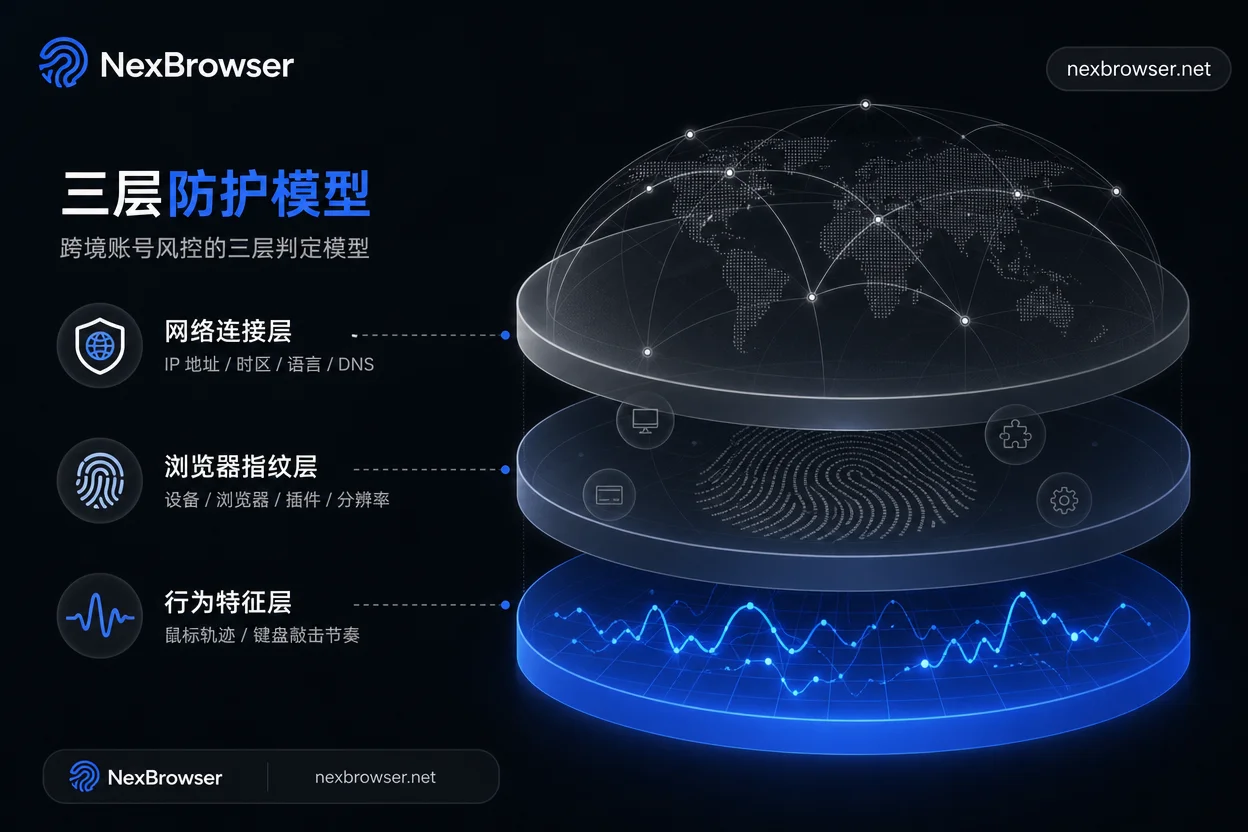
To clarify the problem, we can decompose cross-border account risk control into three non-replaceable layers:
- Layer 1: Network egress and TLS handshake. This includes IP address reputation, proxy type (residential/datacenter), TLS fingerprint (e.g., JA4+), HTTP/2 fingerprint, and TCP/IP stack characteristics. This layer determines the "first impression" when a request reaches the server.
- Layer 2: Frontend JS static fingerprint reading. These are the parameters we see on the fingerprint detection page, including Canvas, WebGL, Audio, fonts, screen resolution, timezone, language, etc. This layer reflects a static snapshot of the browser environment at a specific moment.
- Layer 3: Continuous session behavior telemetry. This is the layer that has been emphasized since July 2026. It doesn't just look at a single instant but observes the entire process from page load to departure: how the mouse moves, keystroke intervals, window focus switches, page visibility, scrolling rhythm, etc.
These three layers are in parallel; any layer being "compliant" only means that layer has passed. Cross-border account risk control is three-dimensional, and an anomaly in any dimension can trigger a challenge.
Layer 1: What egress IP and TLS handshake consistency can and cannot solve
Layer 1 addresses the "who you are" question. The reputation of the egress IP, whether it's from a data center, and whether the TLS handshake features match a real browser determine whether the request can get a "normal admission ticket."
This layer can be verified and compared in batch; it involves deterministic variables. For example, we can check whether egress IPs from different environments belong to the same subnet, or whether TLS fingerprints are identified as features in bot libraries.
But this layer cannot solve: even if the egress IP is a clean residential IP and the TLS handshake perfectly mimics Chrome, as long as the behavior patterns during the session are abnormal—such as mouse trajectories being straight lines, keystroke intervals being perfectly uniform, or the page always in the background—Precursor can still dynamically adjust trust based on behavior scores during the session. Therefore, the claim that "switching to a dedicated residential IP can completely avoid verification" has been directly disproven by official mechanisms after July 2026: IP only decides Layer 1 and cannot mask anomalies in handshake and behavior.
Layer 2: Static fingerprint reading is a one-time snapshot; why it's no longer a sufficient condition
The parameters shown on the detection page are essentially a one-time snapshot read by the browser when executing front-end JS. It reflects the consistency of the environment at that moment but cannot reflect how you operate afterward.
This is the direct reason why "the fingerprint detection page is normal but still prompted for verification": static fingerprint masking solves the consistency problem of Layer 2, but why static fingerprint masking is not enough is that it cannot cover the session behavior telemetry of Layer 3. The JS dynamically injected by Cloudflare Precursor continuously collects behavior signals during the session, like installing a camera in the room, while static fingerprint is just a photo presented at the door.
Thus, parameter consistency is still necessary but no longer sufficient. If operations teams are still investing heavily in "making the detection page all green," they are only solving Layer 2 and not touching Layer 3.
New variables in Layer 3: judgment no longer occurs at a single point in time; credentials may also be revoked during the session
According to security media reports, Cloudflare Precursor is deeply integrated with the cf_clearance cookie, continuously assessing behavior scores during the user session. Once automation or abnormal rhythms are detected, the engine can degrade or directly revoke the session's credential permission online and re-initiate security challenges.
This explains why "it was fine earlier, but now it's blocked again." cf_clearance is no longer a one-time credential issued at login with long-term validity but has become a dynamically revocable permission. The behavioral trend during the session determines whether this permission remains valid.
DataDome's Agent Trust score also changes dynamically during the session journey, with the 100-point score updatable at any time. This means the three-layer judgment is continuous, not set in stone.
Two popular claims directly denied by public facts
Based on the official facts above, two claims circulating in seller communities need to be explicitly denied:
- "Enabling fingerprint masking can 100% bypass verification". Cloudflare Precursor continuously collects behavioral telemetry during the session; mouse trajectories and keystroke time differences are dynamic signals that cannot be masked by a front-end fingerprint parameter. Fingerprint masking only affects Layer 2 and has almost no power over Layer 3.
- "Switching to a dedicated residential IP can completely avoid challenges". IP only determines Layer 1 egress credit; anomalies in TLS handshake and session behavior layers will still be identified. From July to August 2026, update logs of mainstream fingerprint browsers (e.g., AdsPower, Multilogin) mainly focused on kernel upgrades and did not claim to evade session-level behavioral telemetry, indirectly confirming that Layer 3 cannot be solved by changing environment parameters.
Three practices that amplify Layer 3 risks within teams
Although Layer 3 is about behavioral telemetry, many risks are introduced by the operations team itself. The following three practices can significantly amplify the convergence of session rhythms and need special attention:
- Synchronized window operations across environments: If windows in multiple environments are controlled synchronously, mouse trajectories and click intervals are identical, which is an extremely obvious automation feature in behavioral telemetry.
- Batch scripts compressing multiple environments into the same rhythm: Scripts executing operations at fixed intervals can make keystroke time differences and page dwell times highly consistent, easily recognized as programmatic behavior.
- Reusing the same egress for multiple environments: Even if the IP is clean, frequently switching among multiple accounts on the same egress increases Layer 1 risks.
These practices introduce "convergence variables" on the operational side, unrelated to the tools. We simply point out the risks and provide no advice on simulating human trajectories.
Layer-based troubleshooting order: first egress and handshake, then static parameters, finally review operational methods
When encountering "cross-border multi-account repeatedly hit with human verification," it's recommended to check layer by layer in the following order, not reversed:
- Layer 1 (Egress and handshake): Check the egress IP type for each environment, whether they come from the same subnet, and whether TLS/HTTP2 fingerprints are normal. If IPs are flagged or handshake features are abnormal, prioritize resolving these. This layer involves deterministic variables that can be batch-checked.
- Layer 2 (Static parameters): Verify that the fingerprint parameters on the detection page are consistent with the environment, whether masking is effective, and whether cookies and cache are isolated. After confirming, proceed to Layer 3.
- Layer 3 (Operational methods): Review recent operation logs for window synchronization, batch scripts, or fixed rhythms. Because behavior telemetry is continuously assessed, a single point-in-time operation may not trigger, but sustained patterns will.
This order cannot be reversed because the first two layers are objective and verifiable, while Layer 3 requires reviewing operation logs and is more subjective. Eliminate deterministic variables first, then examine behavioral variables.
In NexBrowser: Making the first two layers checkable and auditable
Before discussing tools, a premise must be stated: no tool can guarantee passing session-level behavioral telemetry judgment. The following only explains how to make the first two layers checkable.
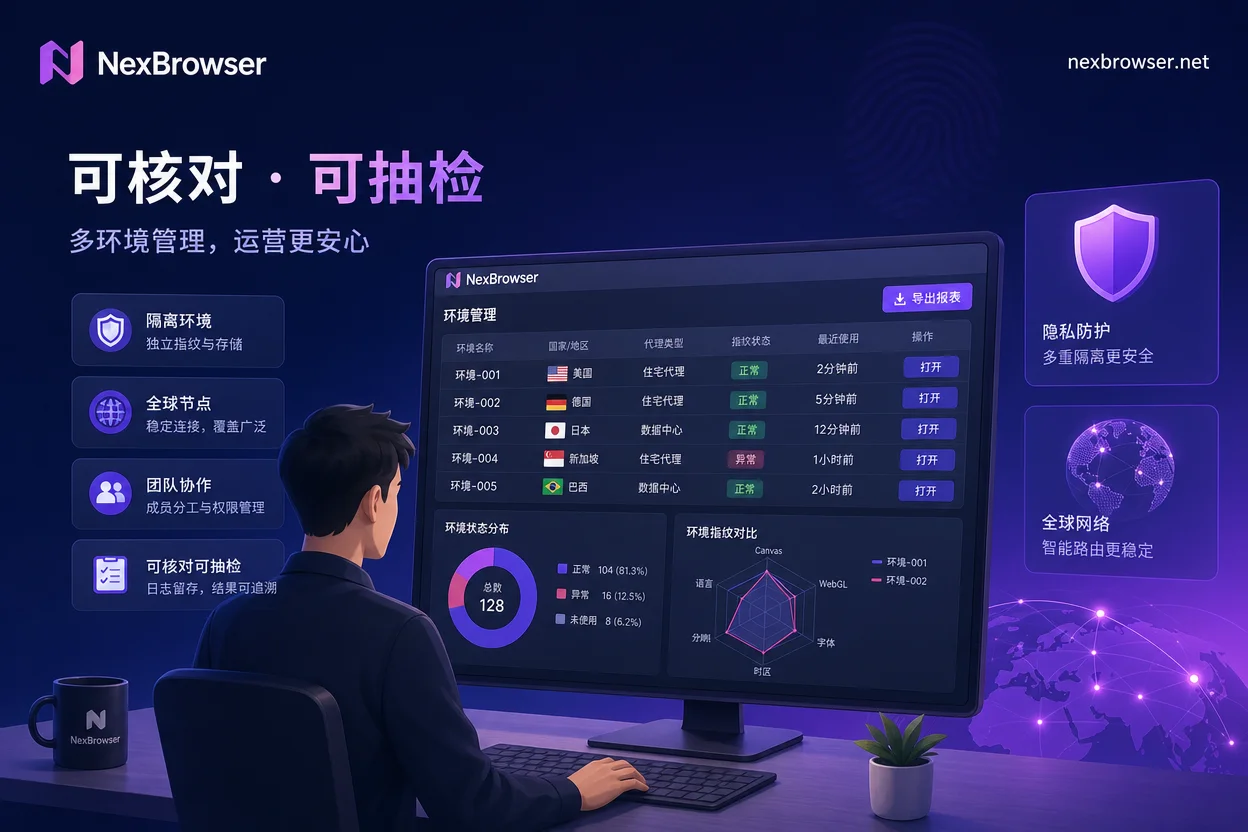
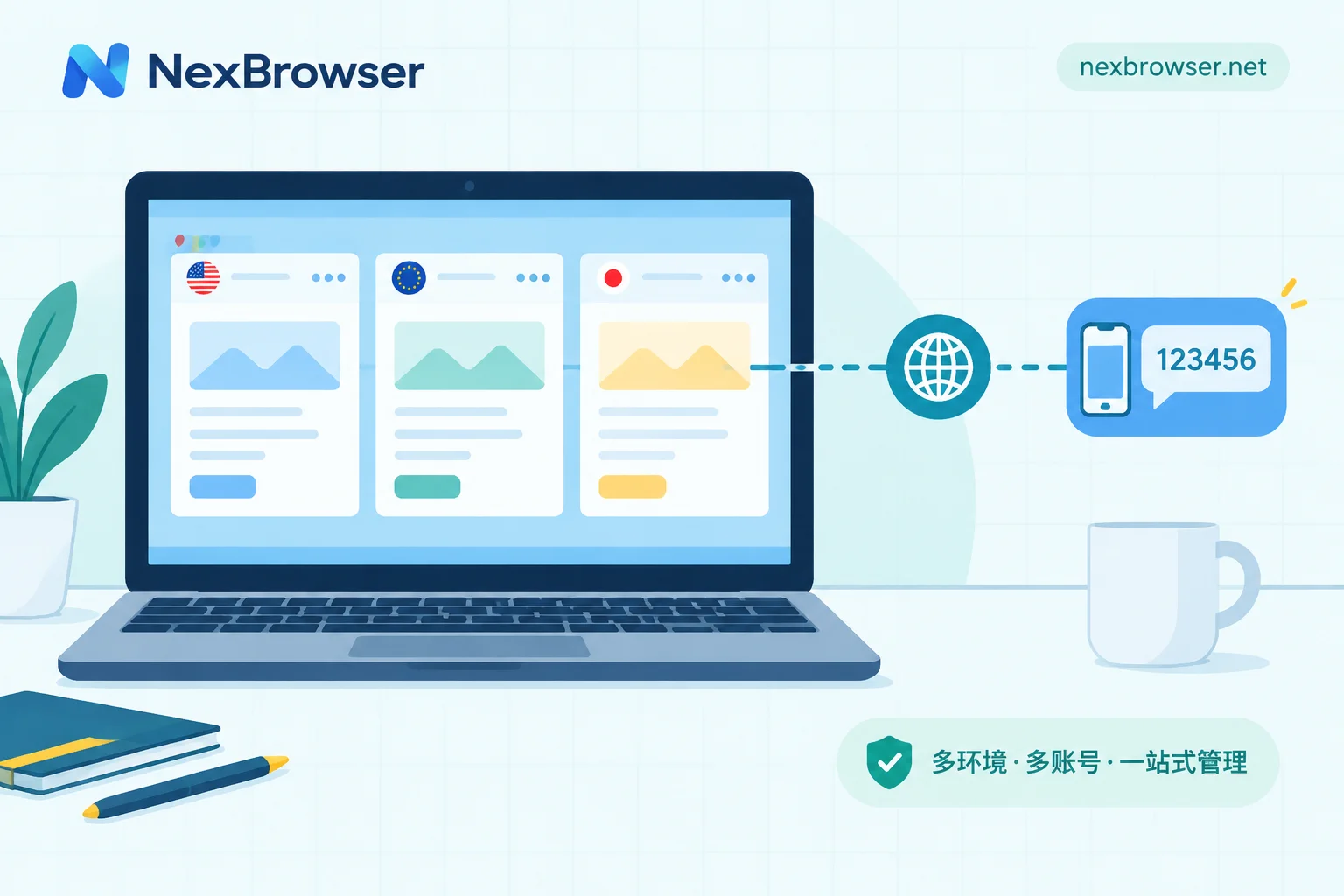
NexBrowser provides isolated browser environments, including fingerprint isolation, cookie isolation, and cache isolation, which correspond to the consistency of static parameters in Layer 2. Each environment opened is a separate browser identity, making it easy to verify detection page parameters one by one.
In proxy management, NexBrowser supports HTTP/HTTPS/SOCKS5 proxies, allowing centralized management of egress for each environment to avoid multiple environments sharing the same IP. Through Local API or WebDriver, operations teams can batch-export each environment's egress IP, fingerprint parameters, etc., for horizontal comparison, turning "feels okay" into "auditable and spot-checkable."
However, it must be clear: if NexBrowser's window sync and no-code RPA features are used to operate multiple environments in sync, they will amplify the session rhythm convergence risk of Layer 3. This part is a variable controlled by the operations side; the tool itself makes no promises about the judgment results of the behavioral telemetry layer.
A one-page checklist and source boundaries
For practical implementation, here is a one-page checklist organized by the three layers:
Layer 1 (Egress and handshake)
- Does the egress IP type (residential/datacenter) match the business scenario?
- Is there any sharing of the same IP across multiple environments?
- Is the TLS fingerprint consistent with the browser version required by the target site?
Layer 2 (Static parameters)
- Are all parameters on the fingerprint detection page consistent with the environment?
- Is the masking feature enabled and effective?
- Are cookies and cache completely isolated?
Layer 3 (Operational methods)
- Has window synchronization been used recently?
- Are there batch scripts running at fixed intervals?
- Are multi-environment operations highly convergent?
Regarding source boundaries, the conclusions cited in this article come from Cloudflare's official press release (2026-07-13), Security Boulevard reports (2026-07-14), and DataDome's official product update (2026-07-14). These are public facts. Vendors have not disclosed the specific degradation model of behavior scores or real-time computation latency, so this article does not speculate further on judgment details. Operational inferences (e.g., "window synchronization amplifies risk") are empirical summaries and may vary across business scenarios. It is recommended that readers conduct a self-check based on their own situations following the above order.



Comments(0)