 NexBrowser指纹浏览器-官方博客Blog
For Amazon sellers holding multiple stores, the 2026 compliance reviews are arriving far more fiercely than in previous years.
From the "brand-association guilt-by-association" ban wave that has continued since the start of the year, to the Section 18 amendment of the Amazon Services Business Solutions Agreement (BSA) that officially took effect in August, and to the US INFORM Consumers Act's 10-day annual verification deadline that keeps countless operations staff on edge—the platform's underlying risk-control logic has fundamentally shifted. It no longer merely checks in isolation whether a single store uses the same IP; instead, it spins a spider web through brand authorization relationships, historical operation traces, service-provider handling trails, and abnormal changes during verification periods to penetrate to the actual controller behind the scenes.
Many sellers are baffled when they receive an "account deactivated" notice: each store clearly has its own dedicated proxy, so why does one small account's incident drag down even the main store that has operated legitimately for years?
Under the current intensity of scrutiny, the traditional "single-point ban prevention" has become ineffective. To achieve Amazon multi-store anti-association in 2026, sellers must understand the platform's latest "guilt-by-association" logic and rebuild their stores' digital isolation assets and daily collaboration workflows from the ground up.
I. Three Major Shifts in Amazon Risk Control in 2026: Why Are You Still Linked Even With "Dedicated IPs"?
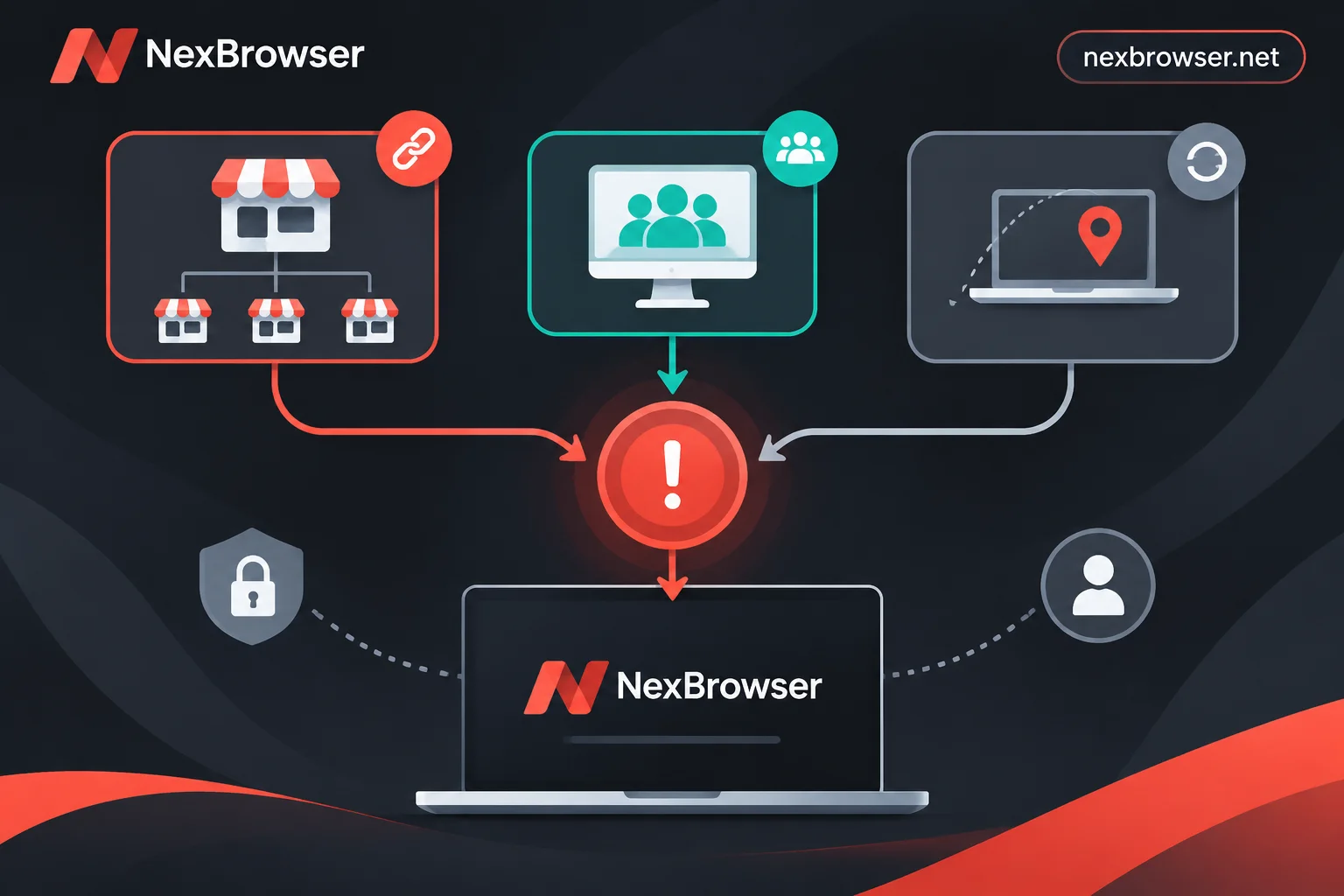
In the past, when discussing why accounts get associated, people first thought of cables, routers, and network cards. But in the multiple large-scale account bans of 2026, the system alarms are often triggered by the following three hidden business intersections:
1. "Brand Guilt-by-Association" and Retrospective Review of Historical Traces
In the 2026 special ban operations (especially the major cleanup targeting certain promotional channel violations and review history), Amazon has adopted a strict "brand guilt-by-association" mechanism. Many sellers habitually authorize their own brands to multiple sub-stores and distribution accounts for product testing or inventory clearance. Once an edge sub-account on the chain violates the rules, the risk-control algorithm traces upward through the Brand Registry authorization network and suspends the main store as well.
What is even trickier is that if the main store and the sub-accounts have ever shared incompletely isolated browser caches during daily operations, or if environment streaming occurs when logging into the brand backend, the system will stack "same controller operating" hard evidence on top of the "brand authorization relationship," causing the appeal channel to directly show "no path to reinstatement."
2. Third-Party Service Providers and "Cross-Client Hidden Associations"
Since March this year, Amazon US has adjusted the brand registry process, changing the previous reply verification code to sending a confirmation email containing a dedicated link to the attorney of record or agency. At the same time, a large number of sellers who "never authorized their brands externally" have also been inexplicably caught up in association bans.
Retrospective analysis reveals that the problem often lies in external collaboration: many sellers directly hand over store credentials to service providers for trademark registration, tax filing, appeals, or agency operations, or let them operate via temporary remote software. If a service provider processes multiple clients' businesses on the same computer and in the same network environment, a fatal "cross-client hidden association" is formed. When someone else's store blows up, yours goes down with it because you once shared those few seconds of environment fingerprints.
3. Tightened BSA Rules and "Environment Mutations" During the INFORM Act Annual Verification Period
Starting August 24, 2026, the new Section 18 of Amazon's BSA officially tightens the transfer of rights and obligations under the agreement, and entity changes and store handovers without official approval face extremely stringent scrutiny. During the 10-day countdown window for INFORM Act annual certification, sellers need to intensively verify identity, bank account, tax, and address information.
During this sensitive stage, if the operator switches computers, the proxy IP suddenly drops and falls back to a direct connection in China, or browser fingerprint parameters are inconsistent before and after, the system will immediately determine that "the account is suspected of being taken over by unauthorized persons or of being bought or sold," directly locking the account and triggering an enhanced legal-representative video verification lasting several dozen minutes.
II. The Breakthrough Approach: Upgrade from "Surface-Level IP Switching" to "Full-Lifecycle Sandbox Isolation"
Facing the platform's cross-verification of "people + links," Amazon multi-store anti-association can no longer rely on patchwork of scattered tools. When we previously discussed how to build an anti-association moat in the era of AI automation, we pointed out that a truly secure defense line must balance underlying parameter self-consistency with the long-term continuity of business flows.
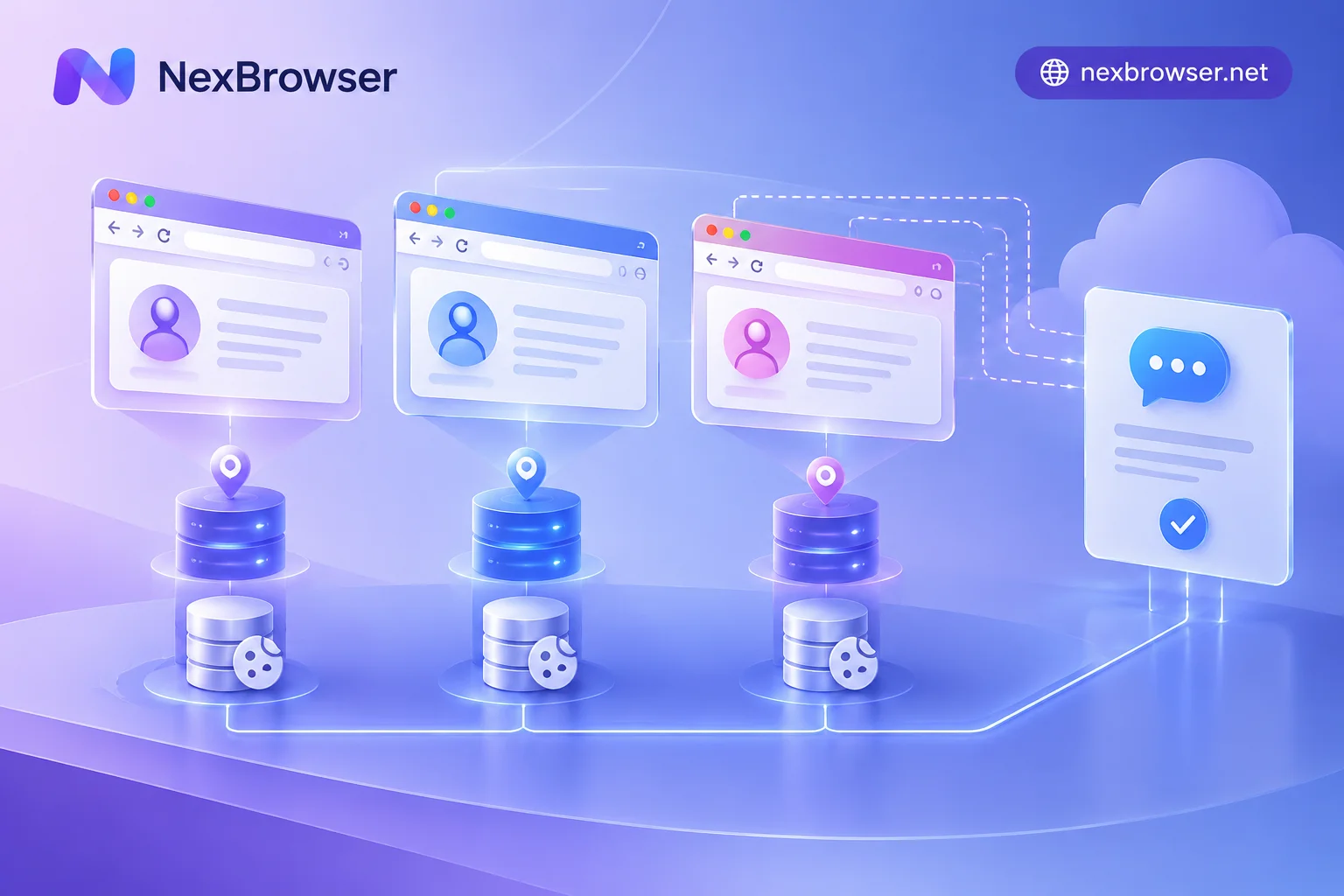
Built on the Chrome kernel, the NexBrowser multi-account fingerprint browser workspace is designed to help cross-border sellers put every store into a completely insulated, independent sandbox on a single computer, neutralizing the three major hidden association risks mentioned above in the cradle.
1. Cut Off Underlying Streaming Between Parent and Child Stores: Deep Isolation That Doesn't Even Spare IndexedDB
When many sellers build brand matrices or test new products across new and old stores, although they open different browser windows, they overlook the depth of modern web detection technologies. Amazon's front-end scripts not only read regular cookies but also deeply detect LocalStorage and IndexedDB databases, and even compare hardware and software rendering characteristics.
In NexBrowser, every store environment has completely independent cookies, cache, local storage (including IndexedDB), and proxy configurations, and environments cannot read one another. For more technical details on underlying storage anti-streaming, refer to our earlier article "How to Make Browser Environment Isolation Truly Thorough."
Meanwhile, at the fingerprint parameters and privacy protection level, NexBrowser independently generates Canvas, WebGL, font, Audio, screen, hardware, User-Agent, and other parameters per environment. These parameters are not chaotic random patches but are made mutually consistent based on built-in real parameter templates for Windows, macOS, and more, and the templates are continuously updated in the cloud with Chrome kernel versions. Even if your main store and distribution sub-accounts are opened simultaneously by the same operator on the same Windows computer, they appear on Amazon's risk-control radar as real, independent devices located in different physical spaces.
2. Protect the Critical Point of Verification Periods: Proxy Pre-Checks Before Launch and Continuous Cloud State Restoration
During INFORM Act annual certification or when modifying sensitive backend information, network exit fluctuation or device changes causing login state invalidation is the last thing you want. If you are interested in such risk-control details, it is recommended to read "How to Configure Proxy IP Binding for Browsers Without Pitfalls."
To eliminate the tragedy of "a proxy suddenly failing and exposing the real IP," NexBrowser has designed strict circuit-breaker mechanisms in its proxy and residential IP module:
- Mandatory pre-check before launch: Each proxy is independently bound to a single store environment. Every time you click to launch an environment, the system first checks the proxy exit's connectivity, latency, and geolocation; if the check fails, the environment absolutely will not launch, blocking direct-connection leaks at the source.
- Automatic alignment of environment parameters: WebRTC policy, system time zone, language, and geolocation automatically match and align with the proxy exit IP, avoiding amateur blunders like "a US IP paired with Beijing time." Sellers can either batch-import their own HTTP / HTTPS / SOCKS5 proxies, or link a NexIP account to one-click bind clean residential IPs by country and region.
- No login state lost when switching devices or proxies: When an old proxy node needs maintenance and an IP change, directly changing the proxy within NexBrowser will not clear existing cookies and local storage. When an environment is closed, core data such as cookies and local storage are encrypted and synced to the cloud according to the selected scope; even if an emergency requires working from home or logging in from another computer (see "Will Switching Computers on an Anti-Association Browser Get Your Account Banned?"), the previous login state can be seamlessly resumed after restoration, smoothly passing through various qualification review periods.
III. Close the "Human Error" Loopholes: How to Safely Collaborate with Team Members and External Service Providers?
With hardware and network handled, the remaining half of Amazon multi-store anti-association lies in "managing people." Whether it is internal handovers between roles or temporarily letting tax agents, appeal service providers, or part-time designers into the backend, the traditional "send account password + receive 2FA code" model hides huge risks of association and asset loss.
To address this pain point, NexBrowser provides a closed-loop solution from number reception to permission control:
1. Passwordless Sharing and Exclusive Locks: Say Goodbye to Passwords Flying Everywhere
In NexBrowser's team collaboration system, the team founder can create custom roles and use the granular role and permission matrix to assign which store groups each member can see and operate. When a store needs to be handed to operations staff or external collaborators:
- No password contact throughout: After binding the Amazon account password to the environment, the login is auto-filled when the window launches, and operators do not need to know the plaintext password.
- Prevention of cross-location concurrent conflicts: The system enforces that "the same environment can only be opened by one member at a time," completely preventing two employees from unknowingly operating the same store in different locations simultaneously and triggering platform anomaly alarms.
- Full-chain traceable audit trails: All data is encrypted during transmission and storage, and permission changes and members' environment open/close records are clearly traceable.
2. Built-in Cloud Phone Numbers in the Sidebar: Elegantly Handle Frequent Two-Step Verification
In 2026, Amazon risk control is particularly sensitive to device verification; new store registration, bill verification, or cross-location collaboration often triggers SMS verification codes. If multiple stores mix employees' personal phone numbers, or verification codes are forwarded everywhere via chat apps, it is not only inefficient but also highly prone to information crossover.
Through the NexSMS cloud phone number center built into the NexBrowser environment sidebar, operations staff can directly obtain numbers, receive SMS, and fill in verification codes by target country/region and platform right beside the current store window. For Amazon main stores that require long-term maintenance, numbers can also be converted to long-term leases (numbers are billed by usage, separately from the browser subscription), giving every store its own dedicated, independent code-receiving channel.
IV. Refined Efficiency: Running Multi-Store Daily Inspections Within Compliance Red Lines
As Amazon fully terminates FBA commingling and upgrades to the new three-column variation management page, sellers' workload for daily inventory checks, ad bid adjustments, and performance health checks has multiplied. If an operator has to manually switch through a dozen stores every day doing repetitive mechanical clicks, it is not only time-consuming but also prone to fatigue errors such as uploading store A's spreadsheet to store B's backend, creating artificial associations.
On the premise that every window still uses its own independent fingerprint, cookies, and proxy, sellers can use NexBrowser's built-in tools to improve efficiency safely:
- Leave human-judgment operations to Window Sync: For example, before a major promotion, you may need to simultaneously inspect the "Account Health" banner notifications or verify promotional prices across multiple stores on the same marketplace. Select a master window and enable Window Sync; clicks, scrolling, and address navigation will be synchronously mapped to the arranged slave windows. You can set operation intervals and throttling, and pause anytime for a store that needs separate handling, balancing efficiency and human control.
- Leave fixed repetitive tasks to RPA scripts or AI Agent: For fixed actions such as scheduled daily downloads of business reports and screenshot archiving of performance panels, you can drag and drop to orchestrate RPA flows on a no-code canvas, or directly command the built-in Nex Agent in natural language. Each environment runs independently in its own sandbox, the execution process can be reviewed, and irreversible operations can be set to require human approval first—freeing your hands while maintaining the security bottom line.
- Build automation in-house for technical teams: If the team has dedicated ERP integration or customized scripting needs, you can directly enable the free, unlimited-call Local API and MCP interfaces and seamlessly take over independent environments with clients such as Playwright, Puppeteer, Claude Code, or Cursor.
Conclusion: Make Anti-Association a Standardized Infrastructure, Not Firefighting
In the 2026 Amazon arena, compliance is no longer an optional elective but a bottom line that determines survival. Whether dealing with the ferocious "brand guilt-by-association" ban sweeps or smoothly passing the scrutiny of the new BSA rules and annual certification, the success rate of spending heavily afterward on writing POA appeal letters is visibly declining. The only reliable solution is to place every account, from the very first day the store is created, into an independent environment with clear rights and responsibilities, self-consistent parameters, and a clean network.
If you are preparing to expand to new marketplaces, or hope to carry out a thorough anti-association compliance upgrade of your existing store matrix before the peak season, you may go directly to the NexBrowser download page to get the Windows client. NexBrowser currently offers a fully functional free tier quota (no credit card required; specific window and member counts are subject to the official campaign page), letting you build your own multi-store secure workspace with zero barriers.