 NexBrowser指纹浏览器-官方博客Blog
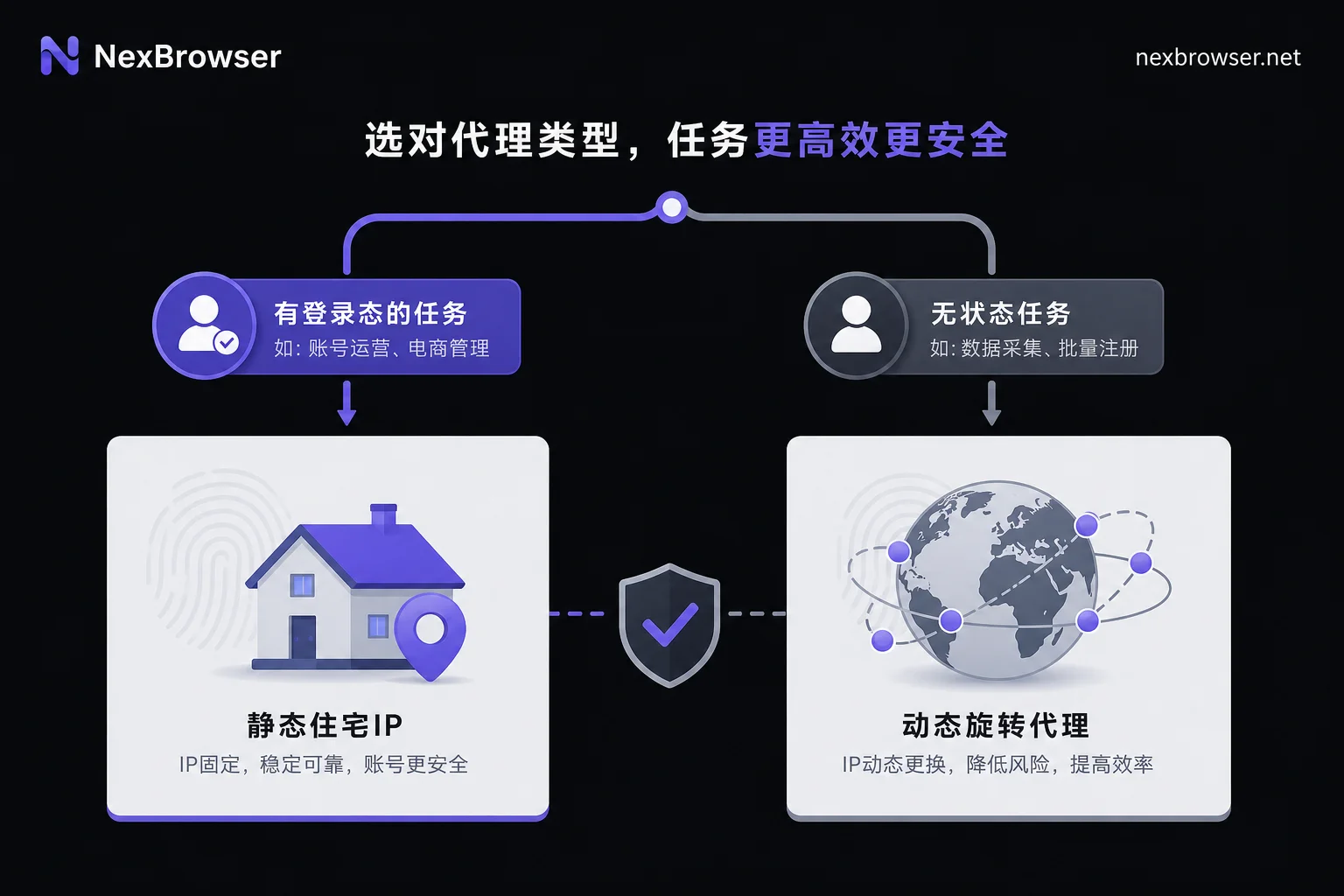
First, run every task through the same test: Would switching the exit IP mid-task destroy an already logged-in session? If yes, use a static residential (ISP) proxy; if no, consider dynamic rotation. This is the basic criterion for combining static residential IPs and dynamic proxies in fingerprint browsers—not by platform or account count, but by the task's session attributes. In July and August 2026, several proxy providers adopted similar distinctions in their selection guides for anti-detect browsers: long-lived login environments bind to fixed IPs, while stateless scraping tasks use rotating proxies.
Start with a Criterion: Would Switching Exit Mid-Task Destroy the Login State?
The core of combining static residential IPs and dynamic proxies in fingerprint browsers is one sentence: Use static for stateful sessions, dynamic for stateless tasks. For tasks with login state—like store backends or main social media accounts—the platform remembers your session after login; if the IP suddenly jumps from City A to City B mid-session, the platform may think the session was hijacked and kick you out with a security checkpoint. Stateless tasks, like scraping public product pages or checking exchange rates, end after one action, and IP changes have no effect. In August 2026, DataImpulse's multi-account management guide clearly warned: using dynamic rotating proxies in logged-in environments may trigger forced logout and security challenges due to sudden IP changes.
Static Residential (ISP) Proxies Are Suitable For: Store Backends, Main Social Accounts, and Long Sessions
Static residential proxies provide a fixed, real ISP-registered IP throughout the service period, supporting a consistently credible network identity in fingerprint browsers. Amazon and eBay store backends, as well as long-term login and daily management of core social accounts, are better bound to this type of proxy. Donut's July 2026 article on anti-detect browser selection also emphasized that static residential proxies are best for e-commerce backends and main social accounts that require long-term stable identity. For eBay-specific environment and proxy binding details, see eBay Seller Account Anti-Association Fingerprint Browser Configuration. Note that using static residential is not a free pass; platform risk controls also look at behavior, environment fingerprints, and store compliance—the proxy only addresses the network exit layer.
If an environment needs to maintain a login state long-term, bind a static residential IP to that environment and do not switch mid-session.
Dynamic Rotating Proxies Are Suitable For: Stateless Scraping, Bulk Queries, and Temporary Access
Dynamic rotating proxies automatically change exit IP per request or on a schedule, making them ideal for public data scraping, price monitoring, bulk queries, and other "can always start over" tasks. Several multi-account proxy selection guides in August 2026 categorized dynamic rotating proxies for stateless scraping scenarios. When selecting a proxy for scraping tasks, focus not on session stability, but on the size of the exit pool and success rate.
What Goes Wrong with Mixing: Mid-Session IP Drift Triggers Geo-Interrogation and Session Interruption
"Will dynamic proxies cause social media account logouts?" The answer is: likely yes. If you attach a dynamic rotating proxy to a logged-in social media environment, when the IP changes mid-session, the platform's security system may see it as an anomalous login from another location and force a logout, followed by a security verification to prove "it's me." The cost of this interruption is often much higher than the small amount of traffic you save by using a dynamic proxy—you may need to redo SMS verification, answer security questions, or even trigger stricter reviews.
Therefore, for accounts where login state cannot be lost, do not place them in a dynamic pool to save money. For parallel multi-backend isolation ideas, see Shopify Multi-Backend Anti-Association Isolation Plan.
Sticky Sessions Are Not Static: Exit IP Can Still Change After Sticky Duration Expires or Node Drops
Sticky Session is a temporary keep-alive feature of dynamic residential proxy pools; it tries to keep the exit IP unchanged for a set time, but stability is limited by the residential device's online status and gateway TTL. Once the underlying residential device goes offline or times out, the gateway automatically assigns a new IP seamlessly. In other words, Sticky's "stickiness" is fragile and can break anytime.
Therefore, Sticky sessions are not suitable for logging into core asset accounts like store backends. They are better for short-term scenarios that can tolerate occasional IP changes, such as one-time promotional warm-ups or short-term data scraping. A-Parser's August 2026 guide also positioned Sticky as a temporary mechanism in dynamic pools, not a long-term fixed solution.
Account Matrix Allocation: Classify by Session Attributes, Not Account Count
Combining static residential IPs and dynamic proxies in fingerprint browsers at the matrix level only requires dividing tasks into two piles: those requiring long-term login state (store backends, main social accounts) and those that are stateless (scraping, queries, temporary access). For the former, bind each environment to a separate static residential IP; for the latter, a shared dynamic rotating pool is acceptable.
Pricing models also affect allocation: static residential proxies are often billed per IP per period (month/year), while dynamic proxies are billed per traffic (GB). If you put long-session tasks in a dynamic pool to save traffic, the savings may not cover the loss from one account risk control. Conversely, binding stateless scraping tasks to static residential is also a waste.
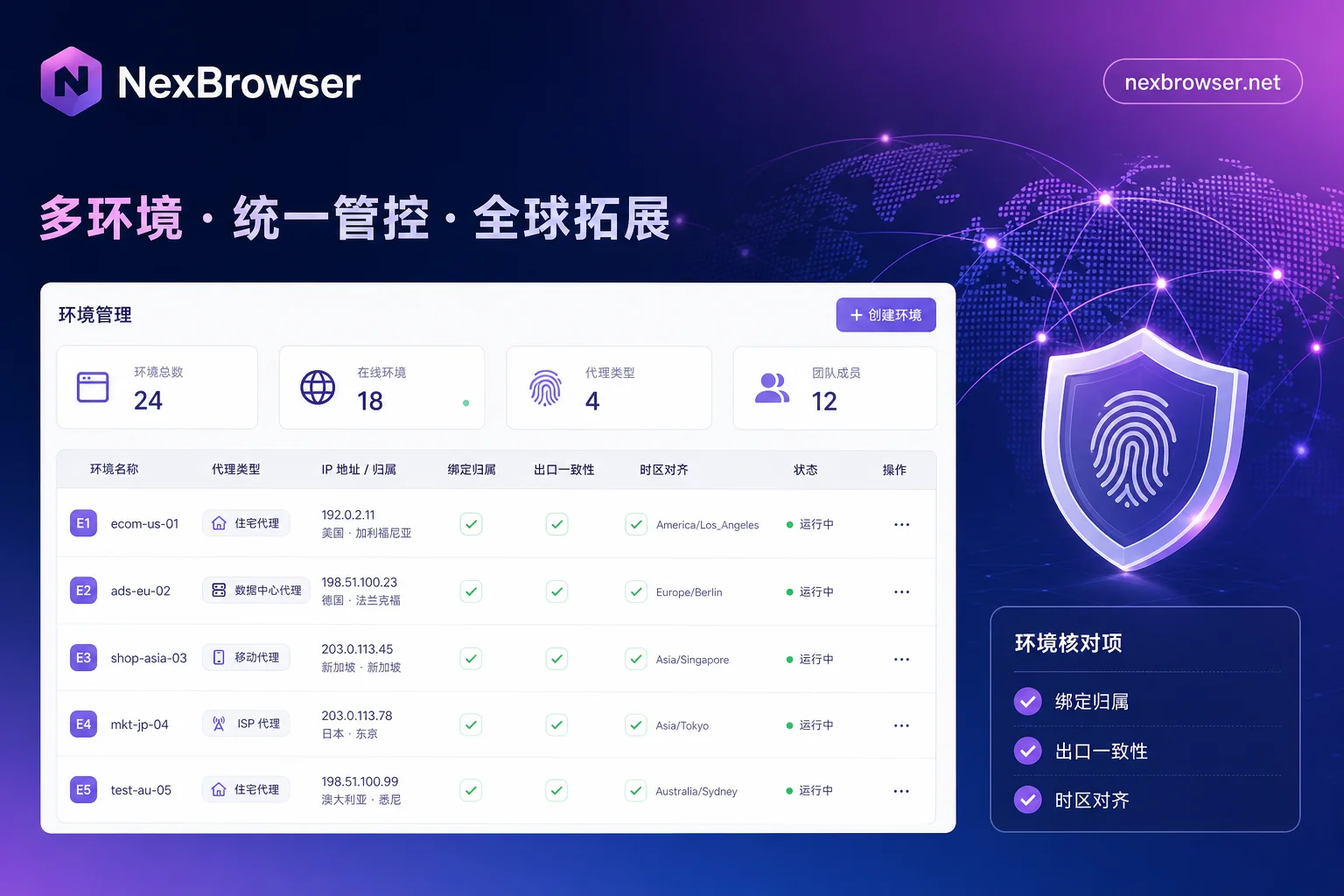
Three More Things to Check After Choosing Proxy Type: Binding Ownership, Exit Consistency, and Timezone-Language Alignment
Choosing the right type is just the first step; three aspects are often overlooked:
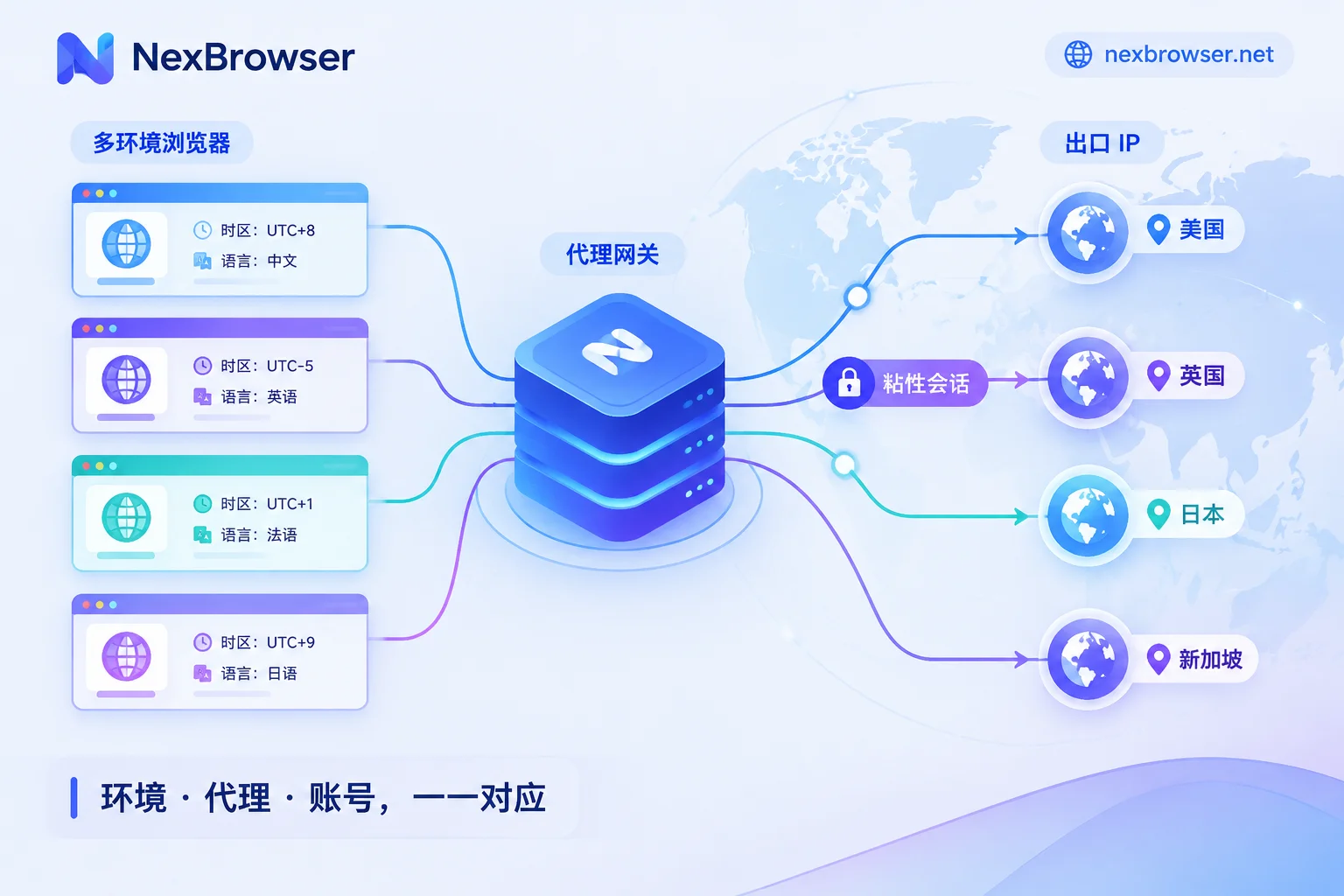
- Proxy should be bound to the specific environment, not set as a system-wide proxy, otherwise multiple environments may share the same exit, exposing associations.
- Exit IP should remain consistent for the same environment during the task, especially for long-session tasks, to prevent mid-session changes; you can use proxy health checks.
- Timezone, geolocation, and language should align with the exit IP's origin; if you haven't enabled "auto-match based on proxy IP" in the environment or there is WebRTC leakage, the platform may still detect geographic conflicts.
If you skip these three checks, even a good proxy type choice may lead to risk control flags. For deeper fingerprint layer risks, read The Role of TLS and JA3 Fingerprints in Cross-Border Risk Control.
Implementation in NexBrowser: Bind Two Types of Proxies by Environment and Perform Exit Checks
NexBrowser supports HTTP/HTTPS/SOCKS5 proxy binding per environment, allowing you to bind static residential and dynamic proxies to different environments, avoiding shared exits from global proxies. During configuration, bind static residential IPs to long-session environments and dynamic proxies to stateless scraping environments, and check "auto-match timezone/geolocation/language based on proxy IP".
For daily operations, you can use window synchronization and Local API to perform exit IP checks on long-session environments—periodically confirm that the exit IP has not drifted during tasks. This is just an available capability; it doesn't mean you won't be risk-controlled, but it helps you catch configuration issues early.
Capability Boundaries: What Proxy Types Cannot Solve
Proxy selection only covers the network exit layer. Whether the main entity information is real, whether business behavior is compliant, and whether platform business rules are followed are not within the proxy's jurisdiction. Additionally, platforms' specific tolerance thresholds and interrogation weights for same-city vs. cross-country IP drift are not public; the judgments in this article are based on industry practice, not official platform standards.
One-Page Proxy Type Allocation Reference Table
| Task Type | Recommended Proxy Type | Binding Method | Key Checks |
|---|---|---|---|
| Store backend (Amazon/eBay) | Static residential (ISP) | Bind independently per environment | Exit consistency, timezone-language alignment |
| Main social account (Facebook/Instagram) | Static residential (ISP) | Bind independently per environment | Exit consistency, WebRTC check |
| Social media secondary account warm-up | Static or Sticky (short-term) | Bind per environment, can change after task | Tolerance for exit drift |
| Public data scraping | Dynamic rotation | Share a dynamic pool across environments | Exit availability, success rate |
| Bulk queries (exchange rate/inventory) | Dynamic rotation | Share a dynamic pool across environments | Exit availability |
| Temporary access (events/lottery) | Dynamic rotation or Sticky | Bind as needed | No need to maintain login state |
FAQ
Can a fingerprint browser environment change IP mid-session?
If the environment has login state (e.g., store backend, main social account), it is not recommended to change. Changing IP tells the platform "your session has been hijacked," which may trigger security challenges or even forced logout. For stateless scraping environments, it doesn't matter and you can change anytime.
What to do if the account requires re-verification after changing proxy IP?
This is usually a sign that the platform thinks the login environment is abnormal. First, check whether the new proxy's IP geolocation matches the account's common region and whether timezone and language are aligned. Then try to resolve the anomaly via SMS or email verification. If it happens frequently, switch back to a static residential IP from the original region and stop changing frequently.
Will dynamic proxies cause social media account logouts?
If the dynamic proxy switches exit IP mid-session, it will likely be judged as a login from a different location, leading to forced logout and security verification. Therefore, main social accounts should bind static residential IPs, and dynamic proxies should only be used for stateless batch operations.
What proxy is suitable for scraping tasks?
Dynamic rotating proxies are recommended for scraping public web data because they change IP per request or on a schedule, distributing request pressure and billing per traffic, which is more economical. For scraping, focus more on availability and success rate of the exit pool, rather than session stability.
Can a sticky session proxy be used to login to a store backend?
Not recommended. Sticky sessions are a temporary feature of dynamic proxy pools; once a residential node goes offline or times out, the gateway automatically assigns a new IP, causing mid-session exit changes. Store backends require long-term stable login state and should bind static residential (ISP) proxies.
What is the difference between static residential IP and dynamic proxy?
Static residential IP stays fixed within the service period, suitable for long-session tasks with login state (store backends, main social accounts); dynamic proxies change IP per request or on a schedule, suitable for stateless scraping and query tasks. The essence of the difference lies in session stability, not simply "static is better" or "dynamic is better."
We suggest you take a pen and classify your account matrix into two categories based on "would switching exit mid-task destroy login state," then check each environment's proxy type and exit ownership, and adjust mismatched environments.


Comments(0)