 NexBrowser指纹浏览器-官方博客Blog
In cross-border e-commerce and overseas social media operations, multi-account management is a core part of daily team activities. However, many operators often face this dilemma: even after changing IP proxies and clearing browser cache, accounts are still detected as linked by platform risk control systems and trigger audits.
The core function of an anti-detect browser is to create completely isolated browser environments at the operating system and rendering layer, generating unique and logically consistent underlying device fingerprints and network configurations for each account, thereby cutting off the association trajectory between accounts physically and logically.
With the 2026 browser kernel technology upgrades and the evolution of platform risk control methods, understanding the technical underpinnings and compliance configuration methods of anti-detect browsers has become key for cross-border teams to ensure asset security.
2026 Underlying Risk Control Upgrades: Why Traditional Anti-Detect Methods Are Failing?
In the Chrome 150 version pushed to the Stable channel in 2026, the Google Chrome team continued to deepen the Privacy Sandbox privacy protection mechanism and API behavior restrictions. Meanwhile, a third-party technical organization, Scrapfly, released a browser fingerprint research report in July 2026, pointing out that modern risk control systems no longer rely solely on cookies or IP checks but have fully shifted to multi-dimensional collaborative detection at the transport layer (TLS handshake, HTTP/2 protocol stack) and JavaScript APIs (Canvas, WebGL, AudioContext, and Client Hints).
Against the backdrop of platforms like Amazon and TikTok Shop further strengthening seller identity and device environment monitoring in July 2026, the reasons traditional anti-detect methods fail are mainly:
- Mismatch of Network and Device Fingerprints: Using a regular browser with a proxy IP changes the IP address, but the browser's Canvas rendering hash, GPU hardware characteristics, and operating system parameters remain unchanged, making it easy to expose traces of the same device's operations.
- Randomized Noise Deemed Abnormal: Some simple anti-detect plugins attempt to confuse fingerprints by randomly injecting fake data, but modern risk control systems can identify forged parameters that "do not conform to real hardware logic," flagging them as high-risk abnormal traffic.
Core Principles and Selection Criteria for Anti-Detect Browsers
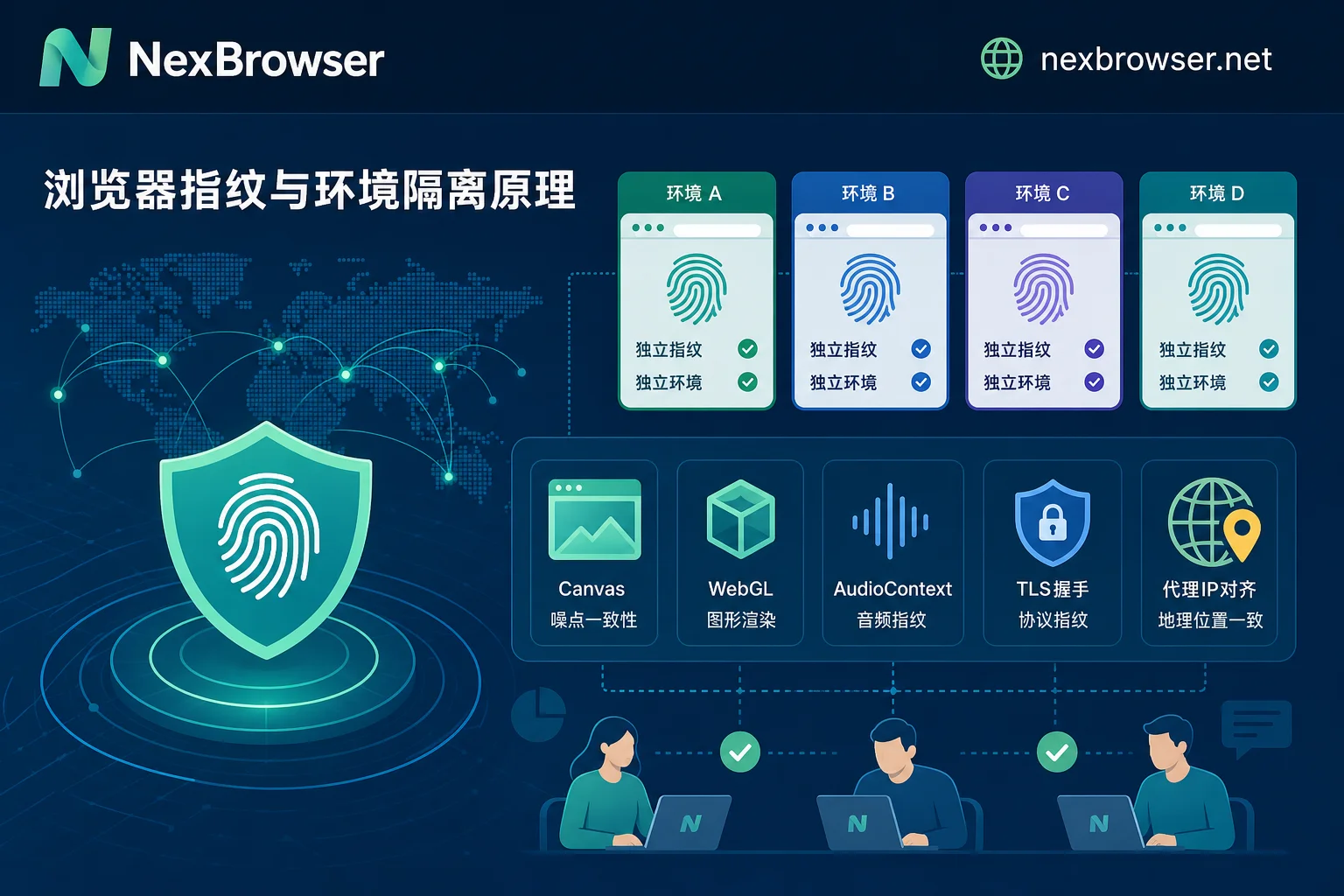
Professional anti-detect browsers do not simply hide data; they deeply modify and independently package each browser profile at the underlying level.
Compliant anti-detect browsers typically have the following core technical architecture:
- Underlying Environment Isolation: Each profile has independent cookies, Local Storage, IndexedDB, and cache files, ensuring complete data isolation.
- Logically Consistent Chrome Fingerprint Simulation: Generate compliant User-Agent, WebGL renderer, Canvas signature, and AudioContext microsecond timing based on the operating system and real hardware parameters, ensuring fingerprint authenticity.
- Precise Proxy Binding: Support HTTP/HTTPS/SOCKS5 proxy management, ensuring that the IP address bound to each environment is fully consistent with the time zone, GeoLocation, and language settings.
When selecting products, operational teams should prioritize kernel update timeliness, proxy protocol compatibility, and team collaboration permission management capabilities, avoiding pseudo-isolation tools that cannot maintain underlying fingerprint consistency.
Multi-Account Compliance Operations: Isolation Configuration Solution Based on NexBrowser
In real cross-border business scenarios, how to achieve efficient multi-account operations while maintaining compliance? As a professional fingerprint browser for cross-border e-commerce and overseas social media teams, NexBrowser provides complete independent environment isolation and multi-account collaboration support.
Below are recommended compliance configuration and operational procedures:
1. Establish Independent and Matched Environment Profiles
When creating new environments in NexBrowser, establish a dedicated profile for each platform account. Configure corresponding HTTP/HTTPS/SOCKS5 proxies based on the account's target country. The system automatically adjusts the environment's time zone and GeoLocation parameters according to the proxy node's time zone and language, ensuring network and underlying simulated fingerprints remain consistent.
2. Strictly Prohibit Data Mixing Across Environments
Leveraging the platform's fingerprint/cookie/cache isolation capabilities, team members perform all operations within independent environments when logging into Amazon or TikTok accounts. Avoid copying and pasting sensitive data with identity tracking characteristics between different profiles.
3. Standardize Team Collaboration and Permission Division
For multi-person collaborative teams, avoid directly sharing account plaintext passwords. Use environment sharing and team collaboration features to securely assign configured browser environments to specific operators, ensuring account credential security while enabling seamless collaboration.
4. Improve Compliance Efficiency with API and No-Code RPA
For teams with daily repetitive compliance operations, use NexBrowser's no-code RPA or Local API/WebDriver interfaces to write automated inspection scripts, automatically executing scheduled checks or product information confirmation, reducing operational misjudgment risks from manual switching.
Summary and Compliance Recommendations
The core value of an anti-detect browser is to "establish a real and independent operating system environment," not to circumvent rules. In 2026, with increasingly sophisticated platform risk control technologies, cross-border teams should abandon crude fingerprint obfuscation methods and turn to security tools with solid underlying kernel and network isolation capabilities.
Soft Action Suggestion: If your team is looking for fingerprint isolation solutions that balance underlying security and efficient collaboration, visit the NexBrowser official website to experience the security operational guarantees provided by independent environment isolation, network proxy management, and no-code RPA.




Comments(0)