 NexBrowser指纹浏览器-官方博客Blog
On platforms such as TikTok, Facebook, Instagram, and X (Twitter), a single official account can hardly sustain a stable customer acquisition funnel on its own. More and more overseas brands, cross-border sellers, and MCN agencies are shifting their focus to social media matrix multi-account management—using main accounts to build the brand, vertical sub-accounts for precise seeding, and multilingual regional accounts to handle localization.
But entering 2026, many operations teams have found that the old "matrix playbook" no longer works: a batch of newly registered accounts gets hit with facial or SMS re-verification before posting more than a few pieces of content; one conversion account gets banned for triggering rules, and the other dozen or so accounts logged in on the same computer are "linked-banned" one after another within days; or, to save effort, they use scripts for one-click synchronized distribution, only to plunge the entire matrix into zero views or a concentrated drop in traffic.
The simultaneous upgrade of platform risk controls and recommendation algorithms has declared the end of the era of "crude account sprawl and mechanical mass control." Today's social media matrix multi-account management is no longer about who has hoarded more accounts, but about who can run an efficient operations pipeline that approximates real human behavior under the premise of absolute isolation of the underlying environment.
I. Why Does Your Social Media Matrix Always Get "Wiped Out All at Once" or Collectively Throttled?
After investigating several recent cases of account bans and traffic drops among cross-border social media teams, the problems can be attributed to failures at three levels:
1. Invisible Linking at the Hardware and Network Underlayer
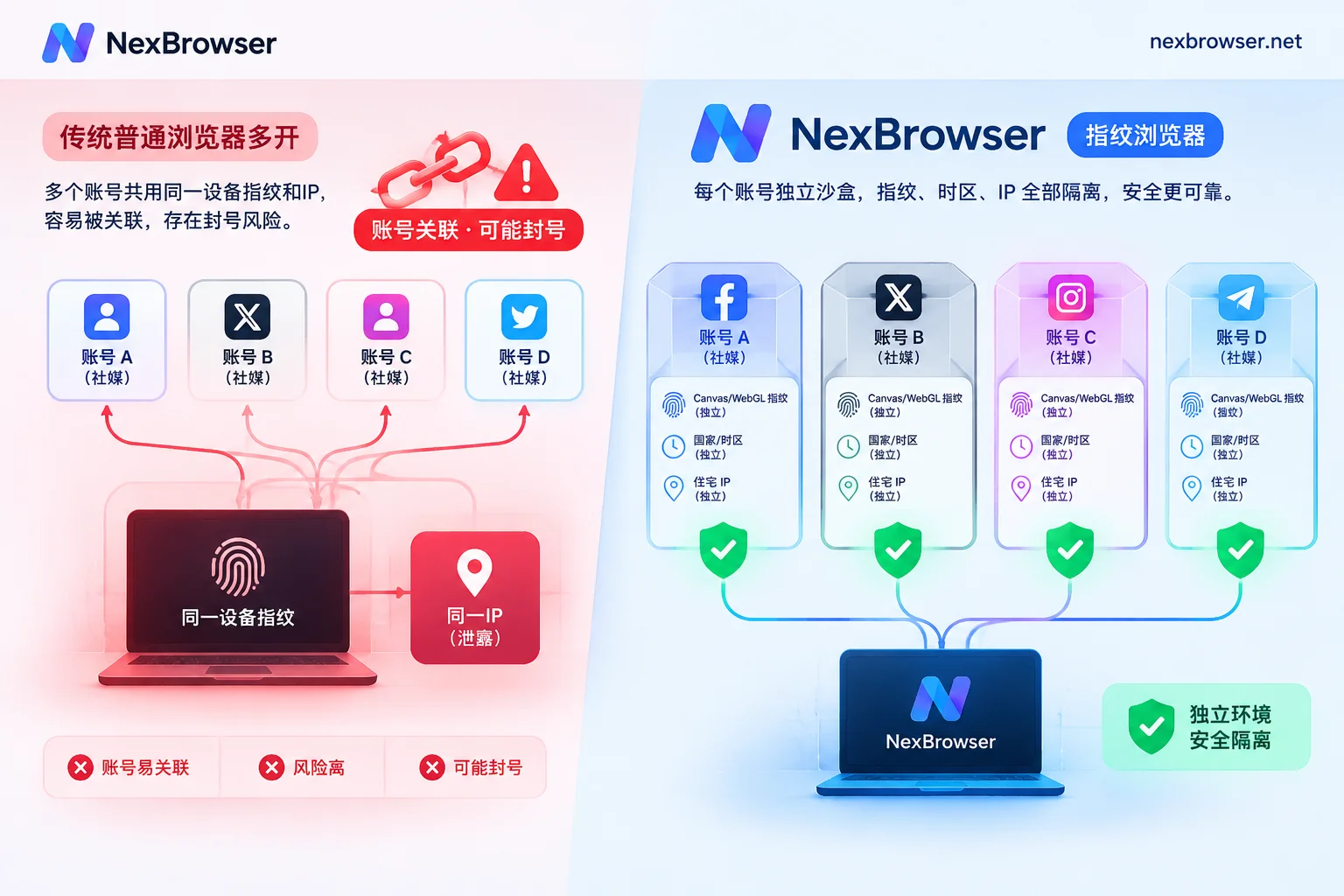
Many beginners think that using Chrome profiles, incognito mode, or clearing the cache is enough to achieve multi-account isolation. In reality, mainstream social platforms collect over 30 dimensions of underlying characteristics, including Canvas rendering, WebGL graphics card features, AudioContext audio fingerprints, local font lists, and system time zone and language. As long as you operate on the same physical device with an ordinary browser, these underlying parameters are highly consistent. Add to that impure proxy nodes or WebRTC leaking the real local IP, and the risk control system can instantly paint this batch of accounts into the same "linkage circle." For the underlying logic of platform tracking, you can refer to the official website's in-depth analysis of why accounts get linked.
2. "Patchwork Environments" Detached from Target Market Characteristics
When running a US-region TikTok or EU-region Instagram matrix, if the bound proxy IP shows New York but the browser exposes a system time zone of UTC+8, an Accept-Language with zh-CN, or even a crude mobile User-Agent forcibly attached on a desktop, this contradictory "Frankenstein" environment will trigger the platform's abnormal risk control alarms the moment you log in. When encountering such problems, it is often necessary to first align the environment according to the troubleshooting method for risk controls triggered by mismatches between IP and browser time zone/language.
3. Mechanized Synchronization and Homogenized Behavior
Once there are many matrix accounts, manually operating each one takes an extremely long time. Some teams directly deploy cheap mass-control plugins, with dozens of accounts clicking publish in the same second and executing the same liking routes with split-second precision every day. In the face of the platforms' current AI behavior detection models, such highly synchronized mechanical trajectories are tantamount to self-detonation.
II. The Robust Architecture of a 2026 Social Media Matrix: Tiered Isolation by the "Pyramid Model"
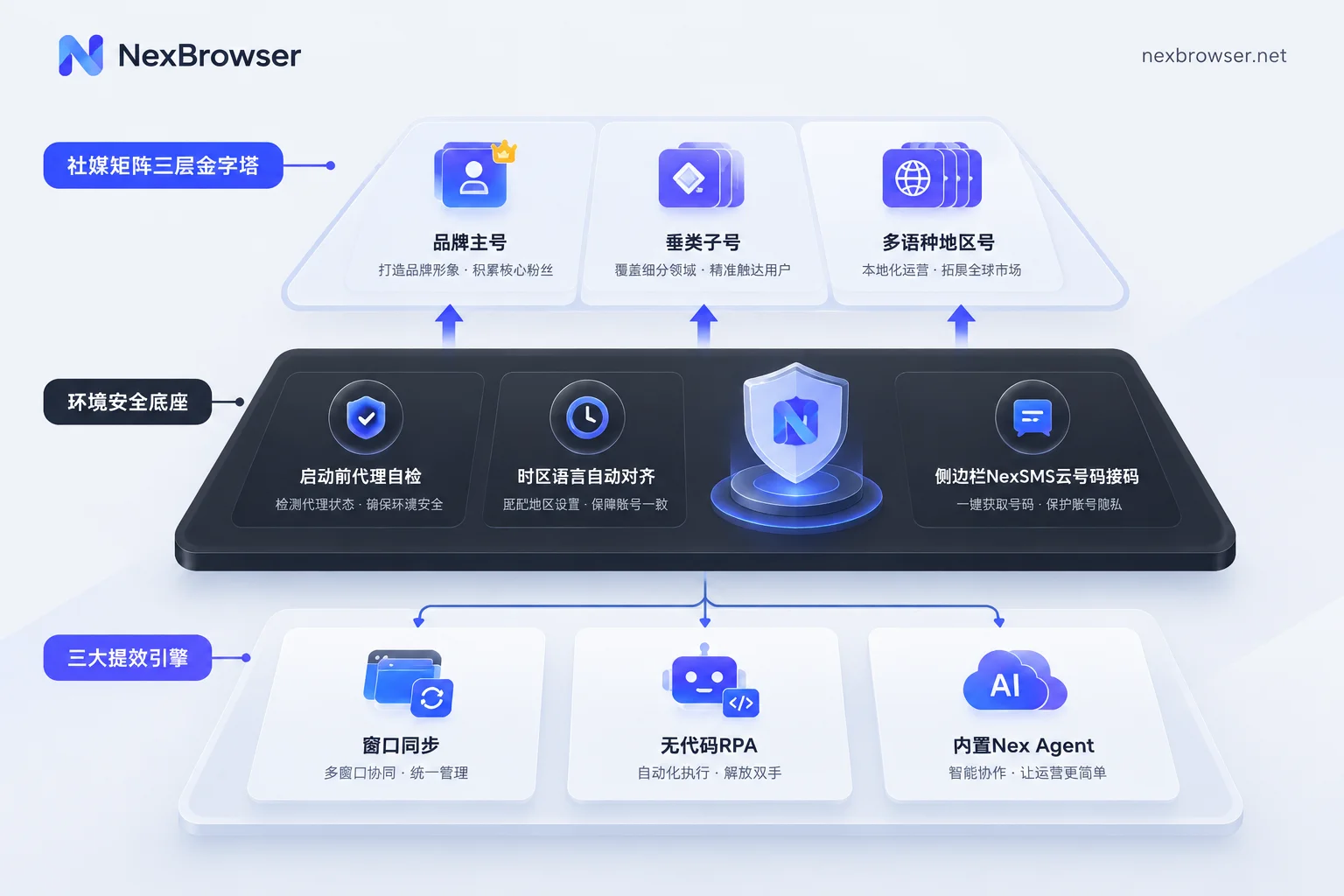
To manage 10, 50, or even hundreds of social media accounts both safely and clearly, the first step is not to rush to post content, but to create tiered profiles according to each account's role in the business chain. Currently, mature overseas teams generally adopt a "three-tier pyramid" structure, which can be directly implemented in the NexBrowser multi-account environment isolation workbench through groups and tags:
- Top tier: Brand main accounts and high-authority official accounts (5%–10%)
Responsible for brand endorsement and core asset accumulation. These accounts demand the highest environmental stability and must follow the iron rule of "one account, one environment, one static residential IP," with frequent network switching or shared use by multiple people strictly prohibited. - Middle tier: Vertical persona accounts and KOS (Key Opinion Sales) sub-accounts (20%–30%)
Built around different product lines, specific pain points, or review personas (for example, in a beauty matrix, an "ingredient-focused review account" or a "workplace commute makeup tutorial account"). Create independent groups by category or business line, maintained by dedicated operations staff. - Bottom tier: Localized regional accounts and traffic testing accounts (60%–70%)
Used for localized distribution, comment-section interception, and trend testing across different language markets such as North America, Southeast Asia, Latin America, and Europe. These accounts are numerous and relatively frequently replaced; the management focus is on batch environment creation, precise alignment of regional proxies, and efficient execution of daily tasks.
III. Fortify the Anti-Ban Baseline: Build a Real "Local Independent Identity" on a Single Computer
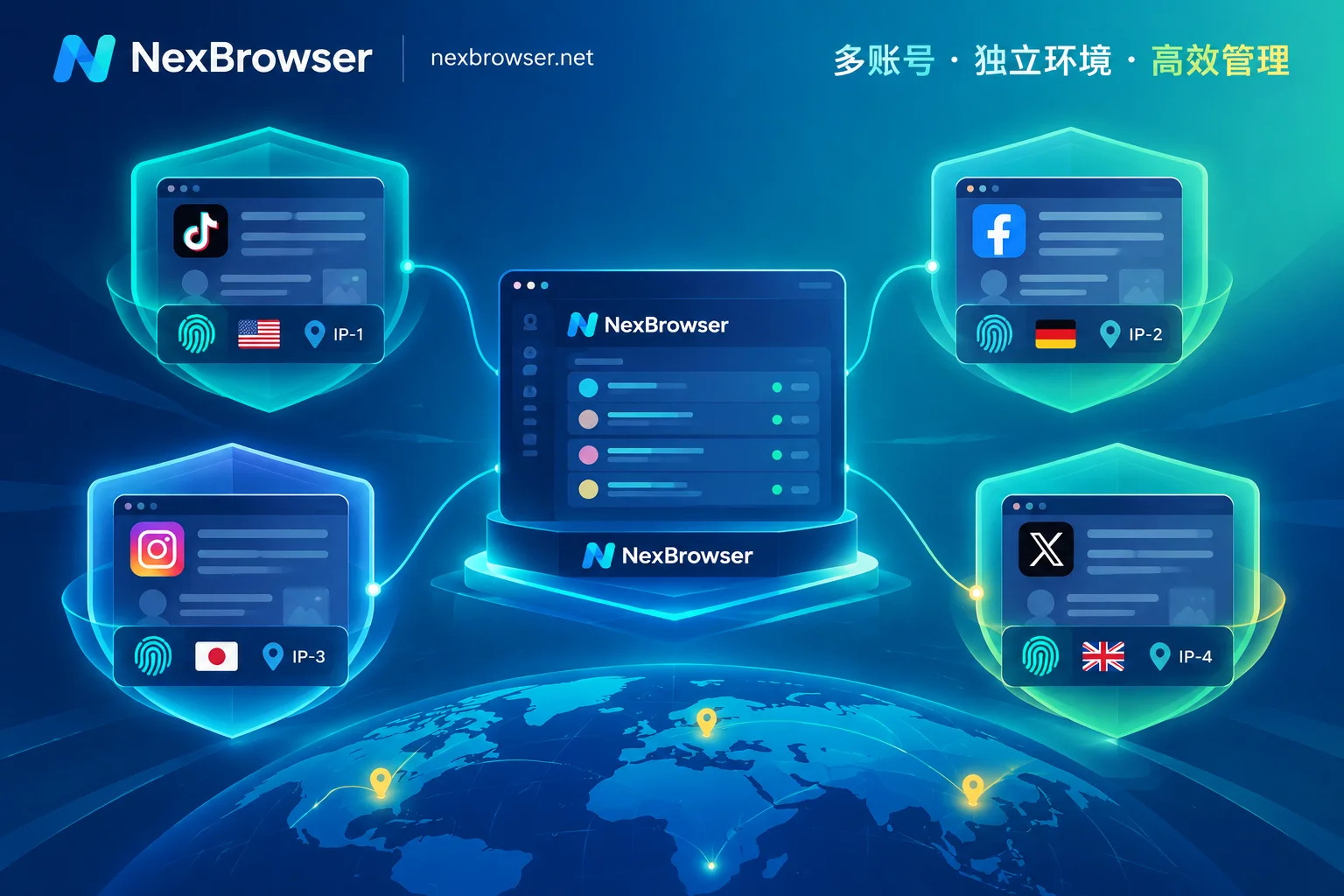
Once the account architecture is clear, the next key is to make the platform believe that behind these dozens of accounts are indeed independent real devices distributed around the world.
1. Completely Cut Off Cache and Underlying Fingerprint Linkage
Each browser environment created in NexBrowser is an independent sandbox based on the Chrome kernel. Each environment has its own independent cookies, local cache, and IndexedDB storage space, and environments do not read from one another. When a window is closed, the login state and local storage are encrypted and synced to the cloud according to the selected scope, so opening it on another computer the next day seamlessly continues the login state and avoids frequent password entry that triggers re-verification.
At the same time, through the browser fingerprint parameter protection mechanism, the system independently generates mutually consistent Canvas, WebGL, Audio, fonts, screen resolution, and hardware concurrency for each environment. You can directly choose built-in Windows, macOS, Android, or iOS parameter templates based on platform characteristics (the template library is continuously updated in the cloud with Chrome kernel versions), making each environment look like a naturally existing terminal in the eyes of the platform.
2. Proxy Egress Checked Before Launch, Network and Environment Characteristics Automatically Aligned
Social media matrices are extremely afraid of "running naked" or proxy disconnections exposing the real local IP. We have already discussed in detail the principles for allocating static residential IPs between important accounts on the same platform and across platforms; in daily implementation, foolproof process design is even more important.
In NexBrowser's proxy and residential IP management module, HTTP / HTTPS / SOCKS5 proxies can be imported individually or in batches. After linking a NexIP account, you can also bind clean residential IPs with one click by target country and region. To prevent node failures from causing linkage bans, NexBrowser provides two key safeguards:
- Mandatory self-check before launch: Before each environment opens, proxy connectivity, latency, and egress location are checked; if the check fails, launch is directly blocked, never allowing an account to load platform pages under an abnormal network.
- Environment characteristics automatically aligned with IP: WebRTC policy, system time zone, interface language, and geolocation parameters automatically match the proxy egress IP, completely eliminating the amateur flaw of "a US IP with a Chinese time zone."
3. Close the Loop for New Account Verification and Re-verification in the Environment Sidebar
For overseas social media matrices, registering new accounts or triggering SMS verification from logging in at a different location is routine. If you turn to scattered SMS-receiving platforms, not only is switching cumbersome, but mismatches between the number's region and the IP's region can easily trigger risk controls. NexBrowser directly embeds the NexSMS cloud phone number center in the environment sidebar, where operations staff can, right next to the current window, obtain numbers, receive SMS, and fill in verification codes by target country/region and social platform; for top-tier main accounts and key mid-tier accounts, numbers can also be converted to long-term leases to handle subsequent irregular security reviews (for details, see the practical process for obtaining numbers and receiving verification codes within a browser environment).
IV. Break Through the Efficiency Bottleneck: Matrix Collaboration with Window Synchronization, RPA, and AI Agent
According to industry field statistics, more than 70% of matrix operators list "multi-account switching and repetitive daily operations" as their biggest efficiency black hole. To both preserve "real human behavioral characteristics" without triggering mechanical risk controls and enable one person to manage dozens of accounts, the key is to break down tasks of different natures and assign them to the right tools (further reading: practical division of labor among built-in AI Agent, RPA, and window synchronization):
| Matrix operations scenario | Recommended tool module | Core pain points solved and anti-risk-control details |
|---|---|---|
| New account cold start, centralized browsing and interaction, temporary campaign configuration | Window Synchronization (Synchronizer) | Operations in the master window drive synchronized clicks, input, and scrolling in multiple slave windows; supports setting operation intervals and throttling to avoid all accounts triggering actions in the same millisecond, while each window maintains independent fingerprints and proxies. |
| Fixed-cycle account nurturing inspections, scheduled dynamic posting, data screenshot archiving | No-code RPA scripts (Beta) | Canvas drag-and-drop orchestration of loops, conditional judgments, and random wait times; one script bound to a batch of environments runs in bulk, failed steps are pinpointed, freeing operators from tedious mechanical clicking. |
| Multilingual homepage inspections, flexible form filling, complex contextual interaction tasks | Built-in Nex Agent (AI Agent) | Issue instructions in natural language; the Agent automatically opens the corresponding environment to operate pages and supports parallel multi-window execution; you can set it to request manual approval before executing irreversible actions (such as formally clicking publish or modifying profile information), balancing intelligence and compliance. |
| Self-built matrix middle-platform integration, customized publishing and data collection pipelines | Local API and MCP Server | Freely opens local HTTP interfaces and the MCP protocol, supporting Playwright, Puppeteer, and clients such as Claude Code and Cursor to directly take over environments, connecting enterprise internal asset libraries and data dashboards. |
Through this combination, teams can save well-tuned standard environments as environment templates; when scaling new accounts, create them in batches with one click and automatically generate brand-new independent fingerprints. With RPA and AI Agent, scaling the matrix no longer equals a linear stacking of labor costs.
V. Multi-Person, Multi-Role Collaboration: Turn Accounts into Team Assets That Cannot Be Taken Away
When the matrix scale crosses the threshold of 20 accounts, collaboration across content editors, distribution operators, ad buyers, and customer service is often required. If you still rely on an Excel spreadsheet to pass around account passwords, not only does every change of person require wrestling with verification codes, but when employees leave, you also face unclear asset handover and security risks.
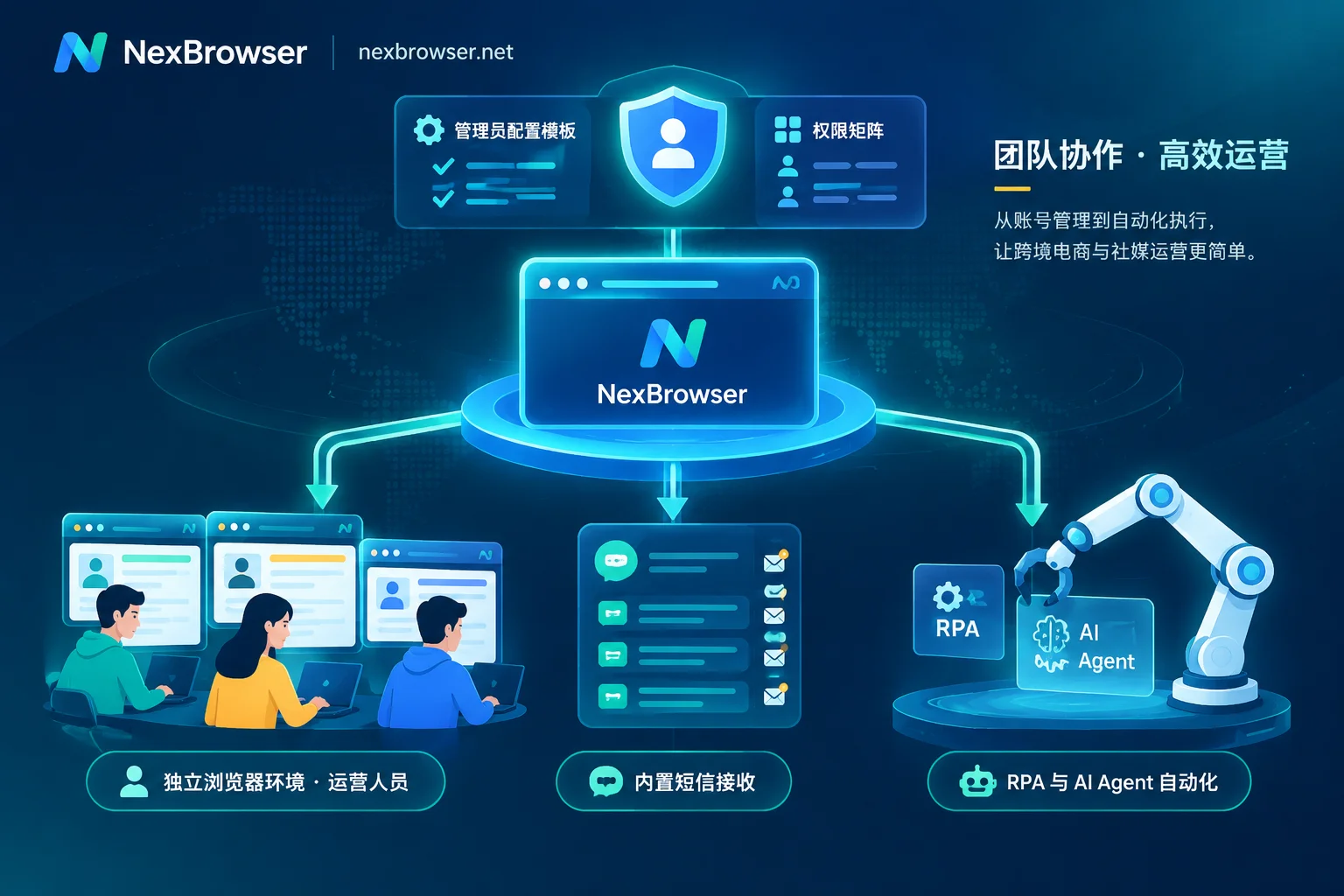
Under NexBrowser's team collaboration system (see the practical guide to implementing a fingerprint browser team collaboration SOP), the daily circulation of a social media matrix can achieve "handing over environments without exposing passwords":
- Divide permission boundaries by business matrix: Administrators can customize roles and authorize by platform, region, or store group in the permission matrix. An operator responsible for TikTok Southeast Asia can only see and operate environments under authorized groups, with no access to Europe/US regions or core brand main accounts.
- Password-free environment sharing and auto-fill: After binding social media account passwords to environments, the system automatically fills in login credentials when members launch windows, so operators never come into contact with plaintext passwords.
- Concurrency conflict locks and operation trails: The same environment can only be opened by one member at a time, completely eliminating abnormal concurrency and cookie overwrites caused by two people operating the same account from different locations simultaneously; all permission changes and member operations are traceable, giving matrix management a real audit trail.
VI. Conclusion: Start Building Your Secure Matrix from a Single Small Closed Loop
Social media matrix multi-account management in 2026 is long past being a game of chance—"buy a bunch of accounts and hope for the best"—and is now a systematic competition around environment compliance, content differentiation, and process automation. First, solidly isolate the underlying fingerprints and clean residential IPs to plug the linkage-ban loopholes; then use group permissions, window synchronization, and AI automation tools to expand the management radius of a single person. Only then can your matrix accumulate into a long-term value-adding digital asset.
If you are preparing a new overseas social media matrix, or are currently troubled by multi-account switching and frequent risk controls, you may visit the NexBrowser client download page to get the Windows client (supporting Windows 10/11 64-bit systems). NexBrowser currently offers a fully functional free tier quota (no credit card required; specific window and member quotas are subject to the real-time terms on the official website's campaign page). You can first use two or three seed accounts to run through the minimal closed loop of "independent environment profiling—proxy self-check alignment—automated daily operations," then steadily expand your global social media footprint.


Comments(0)